If you’ve been researching how to build or scale your web presence, you’ve almost certainly encountered PHP. Yet most articles either read like sales brochures or get lost in technical jargon that doesn’t help you make a real decision. This guide is different. It covers everything a business owner, startup founder, or project manager actually needs to know – what PHP website development services include, what you should expect to pay, which frameworks matter, and the questions you need to ask before hiring anyone.
What Are PHP Website Development Services?
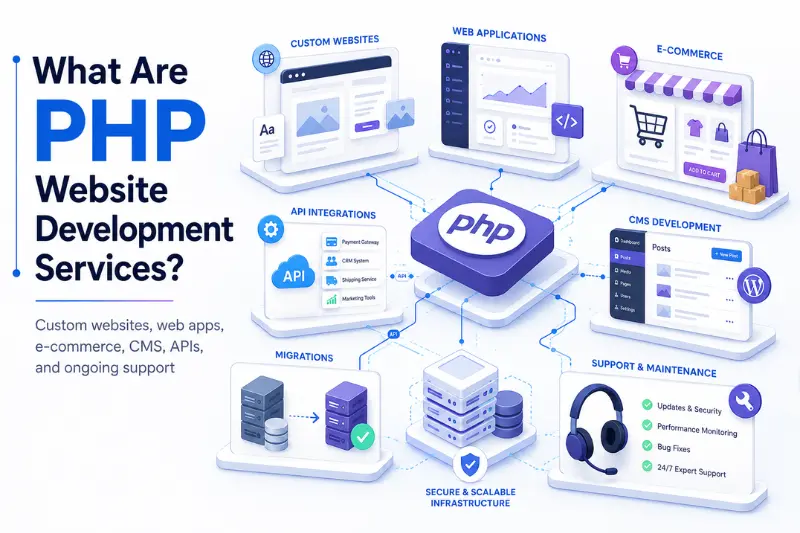
PHP website development services refer to the full range of professional work involved in designing, building, and maintaining web applications using PHP (Hypertext Preprocessor) as the server-side programming language.
These services typically cover:
- Custom web application development – building tailored web tools, portals, dashboards, and platforms from scratch
- E-commerce development – creating online stores using PHP-powered solutions like WooCommerce or Magento
- CMS development – building or customizing content management systems such as WordPress, Drupal, or Joomla
- API development and integration – connecting your website with third-party tools like payment gateways, CRMs, or marketing automation platforms
- Legacy system migration – modernizing outdated PHP codebases to current frameworks and PHP versions
- PHP consulting and code audits – reviewing existing code for performance gaps, security risks, and technical debt
- Ongoing maintenance and support – keeping your PHP application updated, patched, and running smoothly post-launch
A good PHP development partner handles the full lifecycle – from requirements analysis and architecture decisions, through development sprints and QA testing, to deployment and long-term support.
Why PHP Still Dominates Web Development in 2026
Despite decades of competition from newer languages, PHP powers well over 75% of all websites on the internet today – including platforms like WordPress, Facebook (early infrastructure), Wikipedia, and Slack. That’s not inertia. It’s a reflection of genuine practical advantages that are hard to match.
1. It’s Open Source and Cost-Effective
PHP is free to use, with no licensing fees. It runs efficiently on affordable Linux-based servers (the LAMP stack: Linux, Apache, MySQL, PHP), which keeps hosting costs down compared to proprietary platforms. For businesses watching their budget, this alone makes PHP highly attractive.
2. Performance Has Improved Dramatically
PHP 7 and 8 brought substantial speed improvements – roughly twice as fast as older versions in many real-world scenarios. PHP 8.x introduced JIT (Just-in-Time) compilation, further closing the gap with compiled languages. For high-traffic applications, modern PHP handles concurrent requests efficiently without requiring expensive infrastructure.
3. A Massive Developer Ecosystem
There are millions of PHP developers worldwide. According to GitHub and Stack Overflow reports, PHP consistently ranks among the top 10 most-used backend languages globally. That depth of talent means you have real options when hiring -from specialist agencies to freelancers to in-house teams – at a wide range of price points.
4. Seamless Database and Technology Integration
PHP integrates natively with all major relational databases (MySQL, PostgreSQL, SQLite, SQL Server), and connects cleanly with REST APIs, cloud services, and third-party platforms. Whether you need to plug into Stripe, Salesforce, AWS, or a custom ERP, PHP handles it well.
5. A Mature Security Model
PHP frameworks like Laravel and Symfony ship with built-in protections against SQL injection, cross-site scripting (XSS), cross-site request forgery (CSRF), and more. PHP’s long history means security vulnerabilities are well-documented and patches are released regularly.
6. Future-Proof Through Active Development
PHP is actively maintained by a strong global open-source community. Major versions ship with Long-Term Support (LTS) options. Frameworks like Laravel and Symfony release regular updates. You’re not betting on a dying technology – you’re using one with proven staying power.
The Core PHP Frameworks You’ll Encounter
When you hire a PHP development team, they’ll recommend one of several established frameworks depending on your project’s needs. Here’s what each one is actually good for – without the marketing fluff.
Laravel
The most popular PHP framework in the world right now. Laravel offers an elegant syntax, a powerful ORM (Eloquent), a built-in job queue, REST API support, and an enormous package ecosystem. It’s ideal for custom web applications, SaaS platforms, and any project that needs rapid iteration with maintainable code. The trade-off: it’s resource-intensive and may not be the right choice for extremely high-throughput systems that need maximum raw performance.
Symfony
The enterprise-grade choice. Symfony is modular, highly flexible, and built for long-running complex systems. It’s the underlying foundation of several other PHP frameworks (including parts of Laravel). Best for large organizations with complex business logic, regulatory compliance requirements, or systems that need to last many years.
CodeIgniter
Lightweight, fast, and straightforward. CodeIgniter has a smaller footprint than Laravel and is often a good fit for simpler applications, teams that need quick onboarding, or projects where server resources are constrained.
CakePHP
A mature framework with strong convention-over-configuration principles. It’s a solid choice for rapid development, and it includes security features like SQL injection prevention and CSRF protection out of the box.
Yii2
High performance and well-suited for projects with large amounts of data processing. It has a steeper learning curve but shines in data-heavy enterprise applications.
The right framework depends on your project. A trustworthy PHP development partner will explain their recommendation and why it fits your specific use case – not just default to whatever they know best.
What Do PHP Website Development Services Actually Cost?
This is where most articles either avoid giving real numbers or oversimplify to the point of being useless. Here’s an honest breakdown.
Pricing by Project Type
| Project Type | Typical Cost Range |
|---|---|
| Simple brochure / informational website | $1,200 – $5,000 |
| Business website with CMS | $4,000 – $15,000 |
| Custom web application (mid-complexity) | $15,000 – $50,000 |
| E-commerce platform | $10,000 – $60,000+ |
| Enterprise / SaaS platform | $50,000 – $250,000+ |
Pricing by Team Type
- Freelancers: $15–$50/hour depending on experience and location. Good for smaller, well-defined projects. Less suitable for complex builds requiring design, QA, and project management.
- Development agencies: $50–$150+/hour in Western markets. More comprehensive – includes design, testing, documentation, and ongoing support. Higher cost, but lower total risk for complex projects.
- Offshore teams: $15–$40/hour, typically from India, Eastern Europe, or Southeast Asia. Can offer strong quality at lower rates, but requires careful vetting and clear communication processes.
What Actually Drives the Cost
Beyond hourly rates, here are the factors that move your final number significantly:
Complexity and scope – The biggest variable. A site with user authentication, admin panels, role-based access control, and API integrations costs far more than a static site with a contact form.
Custom UI/UX design – Pre-built themes are cheaper to implement. Custom design with wireframes, revisions, animations, and thorough device testing adds meaningful hours to the build.
Third-party integrations – Connecting to payment gateways, CRM systems, or marketing tools typically adds $500–$5,000 per integration, depending on complexity.
Ongoing maintenance – This is where many businesses underestimate total cost of ownership. After launch, you’ll need PHP version updates, security patches, backups, and bug fixes. Budget for a monthly or annual maintenance plan – skipping it leads to security drift and eventually expensive emergency fixes.
Timeline pressure – Projects with compressed deadlines often cost 20-30% more due to larger teams or overtime.
Types of PHP Development Services in Depth
Custom PHP Web Application Development
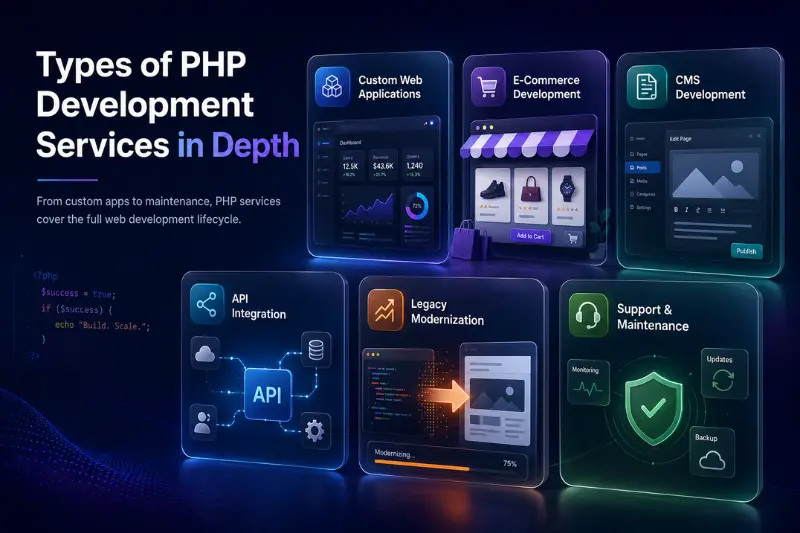
The core of most PHP development engagements. This means building a web application tailored to your specific business processes – not forcing your workflows into a template or off-the-shelf platform. Custom applications typically include database design, user authentication, business logic, admin panels, and reporting.
PHP E-Commerce Development
PHP powers the majority of the world’s e-commerce infrastructure through platforms like WooCommerce (built on WordPress) and Magento. A PHP development team can build a custom storefront, integrate payment processors, set up inventory management, and configure shipping logic – all built around how your business actually operates.
CMS Development and Customization
Content management systems let non-technical teams update site content without touching code. While WordPress is the most common PHP CMS, agencies also build custom CMS solutions using frameworks like Laravel when off-the-shelf options don’t fit the content model or workflow.
API Development and Third-Party Integration
Modern websites rarely operate in isolation. PHP development services include building custom REST or GraphQL APIs, integrating with external services via their APIs, and setting up authentication protocols (JWT, OAuth2) to keep connections secure. Well-built APIs are what allow your website to talk to your CRM, your payment processor, your analytics platform, and your warehouse system.
PHP Legacy Modernization
Many businesses run on PHP applications built 10–15 years ago – often without a framework, on old PHP versions (5.x or early 6.x), with security vulnerabilities and mounting technical debt. Modernization services involve auditing the codebase, migrating to a current PHP version and framework, refactoring problem areas, and improving performance and maintainability – without rebuilding everything from scratch.
PHP Support and Maintenance
The work doesn’t stop at launch. Ongoing maintenance covers monitoring for errors, applying PHP version and framework updates, patching security vulnerabilities, performing backups, and making incremental improvements as your business evolves.
Red Flags to Watch For When Hiring a PHP Development Partner
Most articles tell you what to look for. Equally important is knowing what to avoid.
They can’t explain their framework recommendation. If a team defaults to the same framework for every project without asking about your requirements, that’s a sign they’re not thinking about your needs.
No code ownership clause in the contract. You should own the code. Full stop. Make sure the contract states that explicitly.
No QA or testing process. Any serious PHP development team includes unit testing, integration testing, and user acceptance testing as part of their process – not as an afterthought.
Vague timelines and milestones. Good teams work in sprints with deliverables at each stage. If you can’t get a rough project timeline broken into phases, that’s a warning sign.
No discussion of post-launch support. A team that disappears after launch isn’t a partner – they’re a vendor. Know upfront what support looks like after the site goes live.
Suspiciously low pricing. Extremely cheap PHP development often means cut corners on security, testing, or code quality that cost far more to fix later.
The PHP Development Process: What to Expect
A well-run PHP development project follows a structured process. Here’s what each stage should look like:
1. Discovery and Requirements Analysis
The team reviews your project requirements, asks questions about business logic and user flows, and may conduct market or competitor research. This stage produces a clear project scope and estimate.
2. Architecture and Design
Decisions are made about the framework, database structure, and system architecture. UI/UX design work happens in parallel — wireframes, mockups, and design reviews.
3. Development Sprints
Work is broken into two-week sprints (typically, under agile methodology), with working software delivered at the end of each sprint for your review. This keeps the project transparent and catches misalignments early.
4. Testing and QA
Automated tests run throughout development. Before launch, the application undergoes functional testing, performance testing, security scanning, and cross-browser/device testing.
5. Deployment
The application is deployed to your hosting environment, DNS is configured, SSL is set up, and the team verifies everything is running correctly in production.
6. Post-Launch Support
Monitoring, bug fixes, and iterative improvements begin. A good team stays engaged – this is where long-term partnerships are built.
Questions to Ask Before You Sign a Contract
Before committing to a PHP development partner, get clear answers to these:
- Which PHP framework will you use, and why is it the right fit for my project?
- What does your testing and QA process look like?
- Who owns the code and IP at the end of the project?
- How do you handle changes to the project scope mid-development?
- What does your post-launch support and maintenance offering look like?
- Can you share case studies or references from similar projects?
- How will we communicate during the project, and how often will I see progress?
- What PHP version will the application be built on, and what’s your upgrade path?
PHP vs. Other Technologies: When PHP Is (and Isn’t) the Right Choice
PHP is excellent for most web applications, but it’s worth understanding where alternatives might serve you better.
PHP is the right choice when:
- You’re building a content-driven website, CMS, or e-commerce platform
- You need a large talent pool and affordable hosting
- Long-term maintainability and community support matter
- You’re integrating with established platforms (WordPress, Magento, Drupal)
- Your team or agency already has deep PHP expertise
You might consider alternatives when:
- You’re building a real-time application with high concurrency demands (Node.js might fit better)
- Your team has deep expertise in Python or Ruby and the project doesn’t require PHP integrations
- You’re building primarily for mobile with a thin backend (Python/Django or Node.js APIs are common choices)
That said, PHP 8.x has significantly closed performance gaps that used to make these comparisons starker. For most web projects, PHP remains a very strong default.
What Makes a PHP Website Development Company Worth Hiring?
The best PHP development partners share a few common traits:
Deep framework expertise – They’re not generalists who dabble in PHP. They have senior developers with years of experience in Laravel, Symfony, or whichever framework fits your project.
A documented development process – They can clearly explain how they work, how they handle changes, and what deliverables you’ll see at each stage.
Security-first thinking – They bake security in from the start: input validation, prepared statements, HTTPS, role-based access control, and regular dependency audits.
Clear communication – They set expectations upfront, update you regularly, and flag risks early instead of surprises at launch.
Portfolio depth – They have case studies for projects similar in complexity to yours — not just a gallery of landing pages when you need an enterprise application.
Post-launch accountability – They offer ongoing support and stand behind the quality of their work after delivery.
Frequently Asked Questions
What are PHP website development services?
PHP website development services include designing, building, testing, launching, and maintaining websites or web applications using PHP. These services may cover custom applications, e-commerce stores, CMS development, API integrations, legacy system upgrades, security improvements, and ongoing technical support.
Is PHP still relevant for web development in 2026?
Yes, PHP remains a widely used server-side programming language in 2026. It powers WordPress, many e-commerce platforms, content management systems, business websites, and custom web applications. Modern PHP versions offer improved speed, security, and compatibility with popular frameworks such as Laravel and Symfony.
How much do PHP website development services cost?
PHP development costs vary based on project size, design requirements, integrations, security needs, and the experience of the development team. A simple website may cost a few thousand dollars, while a custom web application, SaaS platform, or enterprise system can cost tens of thousands of dollars or more.
How long does it take to build a PHP website?
A basic PHP website may take three to six weeks, while a custom business application can take two to six months. Large e-commerce platforms, SaaS products, and enterprise systems may require more time because they involve complex features, integrations, testing, and security requirements.
Which PHP framework is best for web development?
The best framework depends on the project. Laravel is a strong choice for SaaS platforms and custom applications. Symfony suits complex enterprise systems. CodeIgniter works well for lightweight projects, while Yii can be suitable for performance-focused and data-heavy applications.
Is PHP secure for business and e-commerce websites?
PHP can be secure when developers follow modern security practices. These include input validation, prepared database queries, HTTPS, secure authentication, access controls, dependency updates, regular backups, and protection against threats such as SQL injection, cross-site scripting, and cross-site request forgery.
Who owns the source code after the project is completed?
Code ownership depends on the contract. The agreement should clearly state who owns the source code, design files, database, documentation, and intellectual property. Businesses should confirm these terms before development begins.
Final Thoughts
PHP website development services represent one of the most mature, cost-effective, and well-supported options in web technology today. Whether you’re a startup building your first web application, a growing business outgrowing an off-the-shelf platform, or an enterprise modernizing legacy systems, PHP and its ecosystem of frameworks offer a proven path forward.
The key is choosing the right partner. Use the questions and red flags in this guide to evaluate your options honestly. A great PHP development team isn’t just a code shop – they’re a technical partner who understands your business goals and builds systems that serve them for years to come.
Have a PHP project in mind? Start with a discovery call – any serious agency will offer this at no charge – and use it to assess how well they listen, how clearly they explain their approach, and whether they ask the right questions about your business before talking about technology.