Ecommerce Website Development Services
Tailored for Your Online Store
We create fast, secure, and SEO-optimized ecommerce websites that boost sales. From Shopify and WooCommerce to fully custom platforms, we provide solutions that grow your online business.
A great ecommerce website doesn’t just “look good.” It loads fast, builds trust, makes buying effortless, and grows with your business. That’s exactly what Ecommerce website development services are for: turning your store into a revenue engine—without the technical headaches.
This guide is written for founders, marketers, and business teams who want clarity. You’ll learn what services include, what it costs, how long it takes, what to ask agencies, and the exact deliverables you should expect—plus the modern best practices competitors often skip.
What Are Ecommerce Website Development Services?

Ecommerce website development services are professional services that plan, build, and optimize online stores so customers can browse products, add to cart, pay securely, and receive orders smoothly.
These services usually cover:
- Strategy & planning (goals, audience, competitive analysis)
- UX/UI design (user experience + user interface)
- Development (front-end and back-end)
- Platform setup (Shopify, WooCommerce, Magento, BigCommerce, headless)
- Integrations (payment, shipping, CRM, ERP, inventory tools)
- Security & compliance (SSL, PCI, data privacy basics)
- Performance optimization (speed, Core Web Vitals)
- SEO foundations (technical SEO + site architecture)
- Testing & launch
- Ongoing support & growth (CRO, A/B testing, maintenance)
Who Needs Ecommerce Development Services?
You’ll benefit most if you’re:
- Launching a new online store and want it done right the first time
- Migrating from one platform to another (e.g., WooCommerce → Shopify)
- Redesigning a store that looks outdated or converts poorly
- Scaling and need advanced features (multi-currency, multi-warehouse, B2B pricing)
- Struggling with speed, checkout drop-offs, or tracking issues
- Adding integrations (ERP, CRM, subscription billing, fulfillment systems)
What’s Different in 2026? (Modern Ecommerce Expectations)
Many “guides” talk about ecommerce basics—but buyers in 2026 expect more. Winning stores focus on:
1) Speed and Core Web Vitals
Slow stores lose sales. A modern build should target:
- Fast page loads
- Smooth interactions
- Stable layouts (no jumping content)
2) Mobile-first shopping flows
Mobile isn’t just responsive design. It’s:
- Thumb-friendly navigation
- Clear product discovery
- Quick checkout options (Apple Pay / Google Pay / Shop Pay)
3) Personalization (without being creepy)
Personalization now means:
- smarter recommendations
- tailored categories
- dynamic merchandising
- based on behavior, not invasive data collection.
4) Accessibility as a standard
Accessible ecommerce is better for everyone:
- clearer navigation
- better contrast and readability
- improved usability across devices
5) Cleaner tech stacks
Many brands are adopting:
- Headless commerce (when needed)
- Composable stacks (best-of-breed tools connected via APIs)
- Better analytics setups and server-side tracking options
What’s Included in Ecommerce Website Development Services?
Here’s what a strong provider should offer (and what you should expect to receive).
Strategy & Discovery
Deliverables often include:
- Goals + KPIs (conversion rate, AOV, CAC, repeat rate)
- Audience research
- Competitor benchmarking
- Platform recommendation
- Sitemap and user flows
UX/UI Design (User Experience + Interface)
You should get:
- Wireframes (page structure)
- High-fidelity designs (final visuals)
- Responsive designs (mobile/tablet/desktop)
- Design system basics (buttons, spacing, typography)
- Accessibility considerations (contrast, forms, navigation)
Development & Setup
Typically includes:
- Theme or custom build
- Product, collection, and content templates
- Checkout setup (as platform allows)
- Payment gateways
- Shipping rules and tax settings
- Customer accounts and order emails
Integrations (Often the “Make or Break” Part)
Common ecommerce integrations:
- Inventory tools and ERPs
- CRMs (HubSpot, Salesforce)
- Email/SMS marketing (Klaviyo, etc.)
- Subscriptions and memberships
- Reviews and UGC tools
- Fulfillment partners and shipping carriers
- Analytics and tracking
Technical SEO Foundations
A strong ecommerce development team will handle:
- Clean URL structure
- Indexable category and product pages
- Schema markup (product, reviews)
- Redirect strategy (especially for migrations)
- Speed-friendly image handling
- Technical audit fixes (404s, duplicates, canonical tags)
Security & Trust Basics
At minimum, you want:
- SSL/HTTPS
- Secure payment processing (PCI handled via gateway)
- Safe admin access practices
- Spam protection for forms
- Backups and restore plan
Quality Assurance & Testing
Before launch, expect testing for:
- Mobile usability and responsive breakpoints
- Checkout flow (including edge cases)
- Page speed and performance checks
- Browser compatibility
- Tracking and attribution sanity checks
- 404s, redirects, and broken links
Launch & Post-Launch Support
Post-launch services often include:
- Monitoring
- Bug fixes
- Performance tuning
- Conversion optimization roadmap
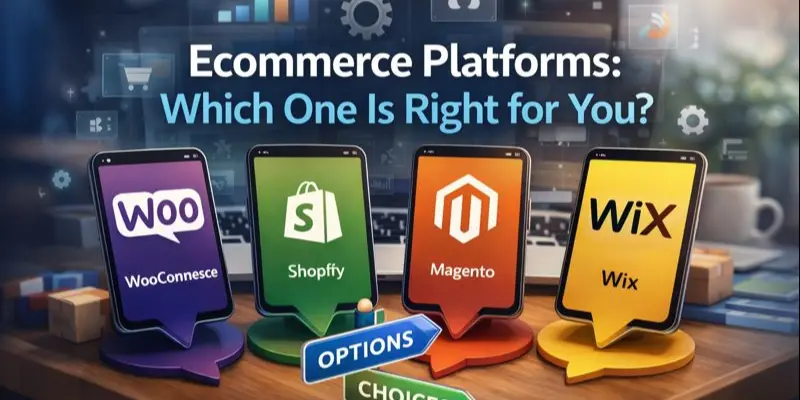
Ecommerce Platforms: Which One Is Right for You?
Shopify / Shopify Plus
Best for:
- Fast launches
- Most DTC brands
- Teams that want simplicity and strong app ecosystem
Watch-outs:
- Some checkout customization limits (depending on setup)
- App bloat can hurt speed if unmanaged
Woo-Commerce (WordPress)
Best for:
- Content-heavy sites (blog-first strategies)
- Brands that want flexibility on WordPress
Watch-outs:
- Maintenance burden can grow quickly
- Plugin conflicts and security upkeep
Magento / Adobe Commerce
Best for:
- Complex catalogs
- Enterprise-grade custom requirements
Watch-outs:
- Higher build and maintenance costs
- Requires stronger technical resources
Big-Commerce
Best for:
- Growing mid-market brands
- B2B features without heavy custom builds
Watch-outs:
Implementation complexity can vary by features
Headless Commerce
Best for:
- Brands needing extreme performance and flexibility
- Complex international setups or unique front-end experiences
Watch-outs:
- Higher upfront cost
- More moving parts (requires ongoing technical ownership)
How Much Do Ecommerce Website Development Services Cost?
Pricing depends on complexity, platform, integrations, and how custom the build is. Here are realistic ranges:
Typical cost ranges (USD)
- Starter store (template-based, light customization): $2,000–$8,000
- Small-to-mid custom store (strong UX, custom sections, basic integrations): $8,000–$30,000
- Advanced ecommerce build (migrations, multiple integrations, custom functionality): $30,000–$120,000
- Enterprise / Headless / Complex B2B: $120,000–$500,000+
Ongoing costs to plan for
- Platform fees (Shopify, hosting, etc.)
- Apps/plugins
- Maintenance/support retainers
- CRO and experimentation (optional but valuable)
Tip: If a quote is unusually cheap, ask what’s excluded (testing, SEO migration, integrations, performance optimization, post-launch support).
How Long Does Ecommerce Website Development Take?
Timelines vary, but here’s a realistic planning guide:
- Starter build: 2–4 weeks
- Custom ecommerce store: 6–12 weeks
- Migration + custom build: 10–16 weeks
- Enterprise / headless: 4–9 months
What makes timelines longer:
- Complex integrations (ERP, multi-warehouse)
- Large product catalogs and messy data
- Slow approvals or unclear requirements
- Content not ready (product photos, copy, policies)
Deliverables Checklist (What You Should Get in Writing)
To avoid surprises, make sure your ecommerce development services include:
Strategy
- Sitemap + user flows
- Feature list and scope
- Tracking/measurement plan
Design
- Wireframes and final designs
- Mobile-first designs
- Design system basics
- Accessibility considerations
Development
- Staging site + production site
- Custom templates/sections
- Integrations implemented and tested
SEO & Migration (if applicable)
- Redirect map
- Technical SEO setup
- Metadata handling (titles, descriptions)
- Schema markup setup
QA & Launch
- QA checklist results
- Speed/performance report (before/after)
- Launch plan + rollback plan
- Post-launch support window
How to Choose the Right Ecommerce Website Development Company
Here’s a simple evaluation framework that most competitor articles don’t provide.
1) Ask for proof that matches your business model
Look for projects similar to:
- your platform (Shopify, WooCommerce, etc.)
- your catalog size (50 SKUs vs 50,000)
- your sales model (DTC vs B2B vs subscriptions)
2) Evaluate their conversion process (not just design taste)
A strong team will talk about:
- customer journey mapping
- product discovery
- merchandising strategy
- reducing checkout friction
- experiment ideas and measurement
3) Check performance capability
Ask:
- How do you prevent apps/scripts from slowing down the store?
- What speed targets do you aim for?
- How do you optimize images and scripts?
4) Confirm integration experience
If you need ERP/CRM/inventory syncing, ask:
- Which ERPs have you integrated with?
- Do you use middleware (like iPaaS) or custom APIs?
- How do you handle failures and data mismatches?
5) Clarify post-launch ownership
Ask:
- Who maintains the site?
- What’s the SLA for issues?
- How are updates deployed and tested?
Red Flags to Watch Out For
Avoid providers who:
- Promise “any feature in any timeline” without discovery
- Don’t include QA and testing in scope
- Skip SEO migration planning (huge traffic risk)
- Can’t explain how they handle speed/performance
- Don’t define deliverables clearly
- Push too many apps/plugins without a performance plan
- Offer no post-launch support option
RFP Questions You Can Copy-Paste (Agency/Developer Vetting)
- Use these when hiring ecommerce website development services:
- What platform do you recommend for our goals—and why?
- What are the exact deliverables by week (strategy, design, build, QA, launch)?
- How do you approach CRO and improving conversion rates?
- What performance targets do you aim for, and how do you measure them?
- How will analytics and tracking be implemented and validated?
- How do you manage SEO during redesigns/migrations (redirects, metadata, indexing)?
- What integrations have you built before that match our stack?
- Who owns the site after launch (support, bugs, updates, security)?
- What risks do you see in our project, and how do you reduce them?
- What does post-launch optimization look like in the first 90 days?
What Great Ecommerce Development Looks Like (90-Day Post-Launch Plan)
Most stores fail after launch because they stop improving. A strong partner will recommend:
Weeks 1–2: Stabilize
- Fix launch bugs
- Validate payments, shipping, emails
- Confirm tracking accuracy
Weeks 3–6: Optimize conversion
- Improve product pages (trust signals, reviews, FAQs)
- Reduce checkout friction
- Improve search and filtering
- Run 1–2 A/B tests (or structured experiments)
Weeks 7–12: Scale growth
- SEO content expansion (collections, guides, internal linking)
- Landing pages for paid campaigns
- Performance tuning
- Retention improvements (email/SMS flows)
FAQs About Ecommerce Website Development Services
They’re related but not identical. Design focuses on how the site looks and feels. Development builds the actual store, functions, integrations, and performance.
Only if you truly need it. Many brands can scale very far on Shopify Plus or BigCommerce with smart optimization. Headless is best when performance, flexibility, or architecture demands justify the extra complexity.
A smooth buying experience: fast pages, simple navigation, strong product pages, and a frictionless checkout. Everything else supports that.
Yes—if they include UX improvements, speed optimization, trust signals, better product discovery, and data-driven testing after launch.
Final Takeaway
The best ecommerce website development services don’t just build a store—they build a system for growth: fast performance, clean SEO foundations, reliable integrations, and a clear plan to improve conversion rate after launch.
If you want, I can also:
- tailor this article to your brand voice (agency, studio, SaaS, freelancer collective, etc.)
- add a service-page version (more sales-oriented with CTAs)
- create an FAQ schema block, outline, and internal linking plan for SEO