Introduction
In today’s digital world, a website is one of the most important assets for any startup. Before customers contact your business, purchase your product, or request your services, they usually visit your website. A professional website helps startups build trust, generate leads, attract customers, and grow faster.
However, creating a successful startup website requires more than just a beautiful design. It needs proper planning, user-friendly navigation, fast loading speed, strong SEO, and a clear conversion strategy.
This guide explains everything you need to know about website development for startups, helping you create a website that supports long-term business growth.
Why Website Development Is Important for Startups
A website acts as your online headquarters. It works 24/7 to represent your business and connect with potential customers.
Benefits of a startup website include:
- Building brand credibility
- Generating qualified leads
- Increasing online visibility
- Reaching a wider audience
- Improving customer support
- Showcasing products and services
- Driving sales and conversions
Without a professional website, startups may struggle to compete in today’s digital marketplace.
Planning Your Startup Website
Before development begins, you need a clear plan.
Define Your Goals
Ask yourself:
- Do you want to generate leads?
- Do you want to sell products online?
- Do you want users to book appointments?
- Do you want to build brand awareness?
Your goals will determine your website structure and features.
Identify Your Target Audience
Understanding your audience helps create a website that meets their needs.
Consider:
- Age group
- Location
- Interests
- Problems they face
- Online behavior
A customer-focused website usually performs much better than a company-focused website.
Analyze Competitors
Study successful competitors in your industry.
Look at:
- Website structure
- Design style
- Content strategy
- Calls-to-action
- User experience
This can help you identify opportunities and avoid common mistakes.
Essential Pages Every Startup Website Needs

Every startup website should include these pages:
Homepage
Your homepage should clearly explain:
What your business does
Who your products or services are for
Why customers should choose you
About Us Page
Tell your company’s story and explain:
- Mission
- Vision
- Team members
- Company values
Products or Services Page
Describe:
- Features
- Benefits
- Pricing
- Solutions offered
Focus on customer benefits rather than technical details.
Contact Page
Include:
- Contact form
- Email address
- Phone number
- Social media profiles
Blog Page
A blog helps improve SEO and establish authority within your industry.
FAQ Page
Answer common customer questions and reduce objections before purchase.
Choosing the Right Platform
The best platform depends on your startup’s needs.
| Platform | Best For |
|---|---|
| WordPress | Business websites and blogs |
| Shopify | E-commerce startups |
| Webflow | Design-focused websites |
| Wix | Small startup websites |
| Custom Development | SaaS products and advanced projects |
Most startups start successfully with WordPress because it is flexible, affordable, and scalable.
Website Design Best Practices for Startups
Keep the Design Simple
Avoid cluttered pages.
Focus on:
- Clean layouts
- Easy navigation
- Clear messaging
- Consistent branding
Use Mobile-First Design
Most website visitors use smartphones.
Your website should:
- Adapt to all screen sizes
- Load quickly
- Be easy to navigate on mobile devices
Create Strong Calls-to-Action
Examples include:
- Get Started
- Request a Demo
- Contact Us
- Start Free Trial
Every page should encourage users to take action.
SEO for Startup Websites
SEO helps your website appear in search engine results.
Keyword Research
Target relevant keywords such as:
- Website development for startups
- Startup website development
- Startup web design
- Website design for startups
On-Page SEO
Optimize:
- Page titles
- Meta descriptions
- Headings
- URLs
- Images
Technical SEO
Ensure:
- Fast website speed
- Mobile responsiveness
- Secure HTTPS connection
- XML sitemap
- Proper internal linking
Content Marketing
Publish useful content regularly to attract organic traffic.
Examples include:
- Industry guides
- Tutorials
- Case studies
- How-to articles
Website Development Cost for Startups
Costs vary depending on project complexity.
| Website Type | Estimated Cost |
|---|---|
| DIY Website | $100–$500 |
| Freelancer | $500–$5,000 |
| Agency Website | $2,000–$15,000 |
| Custom Startup Website | $5,000–$50,000+ |
| SaaS Platform | $10,000–$100,000+ |
Startups should focus on essential features first and scale gradually.
Conversion Rate Optimization
- Traffic alone is not enough.
- Your website should encourage visitors to become customers.
Effective CRO techniques include:
- Customer testimonials
- Trust badges
- Clear CTAs
- Simple forms
- Case studies
- Social proof
These elements increase trust and improve conversion rates.
Website Speed Optimization
Fast websites improve both SEO and user experience.
To improve speed:
- Compress images
- Use caching
- Minify CSS and JavaScript
- Use a CDN
- Choose reliable hosting
Aim for a loading time under three seconds.
Security Best Practices
Protect your startup website by implementing:
- SSL certificates
- Strong passwords
- Two-factor authentication
- Regular backups
- Security plugins
- Software updates
AI Tools for Startup Website Development
Modern startups can save time using AI-powered tools.
Popular options include:
- ChatGPT for content creation
- GitHub Copilot for coding
- Framer AI for website design
- Jasper for marketing content
- Durable AI for website building
AI tools can accelerate development while reducing costs.
Common Website Development Mistakes Startups Make
Avoid these mistakes:
- Ignoring SEO
- Slow website speed
- Poor mobile experience
- Weak calls-to-action
- Overcomplicated navigation
- Lack of analytics tracking
- Focusing only on design
A successful website balances design, performance, and functionality.
Website Launch Checklist
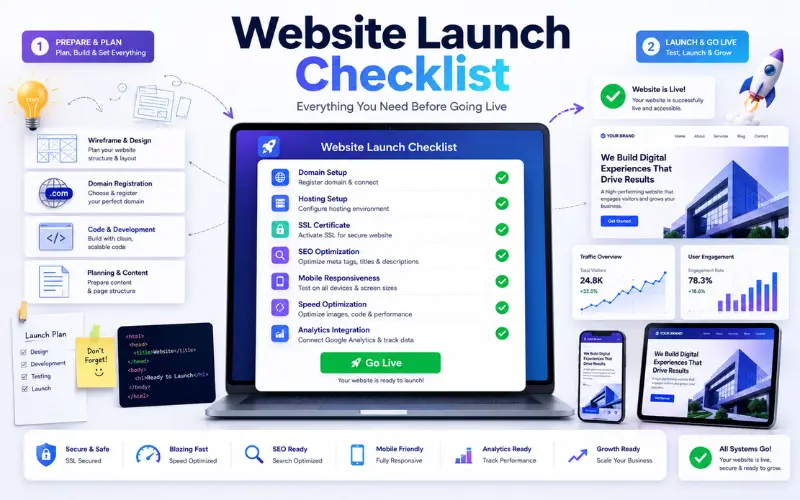
Before launching your website:
- Test all pages
- Check forms
- Verify mobile responsiveness
- Install SSL
- Set up analytics
- Optimize page speed
- Proofread content
- Configure backups
- Submit sitemap to Google
A proper launch process reduces future problems.
Key Metrics to Track
Monitor these important metrics:
- Organic traffic
- Conversion rate
- Bounce rate
- Average session duration
- Leads generated
- Revenue from website visitors
Tracking data helps improve website performance over time.
Frequently Asked Questions
What is website development for startups?
Website development for startups is the process of planning, designing, building, and maintaining a website that helps a new business establish its online presence, attract customers, generate leads, and support growth.
How much does website development for startups cost?
The cost of website development for startups can range from $100 for a basic DIY website to over $50,000 for a custom-built platform. The final cost depends on the website’s features, complexity, design requirements, and development approach.
Which platform is best for startup website development?
WordPress is often the best choice for startup website development because it is affordable, flexible, SEO-friendly, and easy to scale. However, Shopify is ideal for eCommerce startups, while custom development may be better for SaaS businesses.
How long does it take to develop a startup website?
A simple startup website can take 2–4 weeks to build, while more advanced websites with custom features may require several months. The timeline depends on the project’s size, functionality, and development resources.
Why is SEO important for startup websites?
SEO helps startup websites rank higher in search engines, attract organic traffic, and reduce customer acquisition costs. A strong SEO strategy can generate consistent leads and improve online visibility over the long term.
What features should every startup website include?
Every startup website should include a homepage, about page, product or service pages, contact page, blog, FAQ section, mobile-friendly design, fast loading speed, clear calls-to-action, and basic security features such as SSL encryption.
Conclusion
Website development for startups is one of the most important investments a business can make. A well-planned website helps attract customers, improve credibility, generate leads, and support long-term growth.
By focusing on user experience, SEO, mobile responsiveness, security, and conversion optimization, startups can create a website that delivers real business results. Rather than treating your website as a simple online brochure, view it as a growth engine that works around the clock to support your business goals.