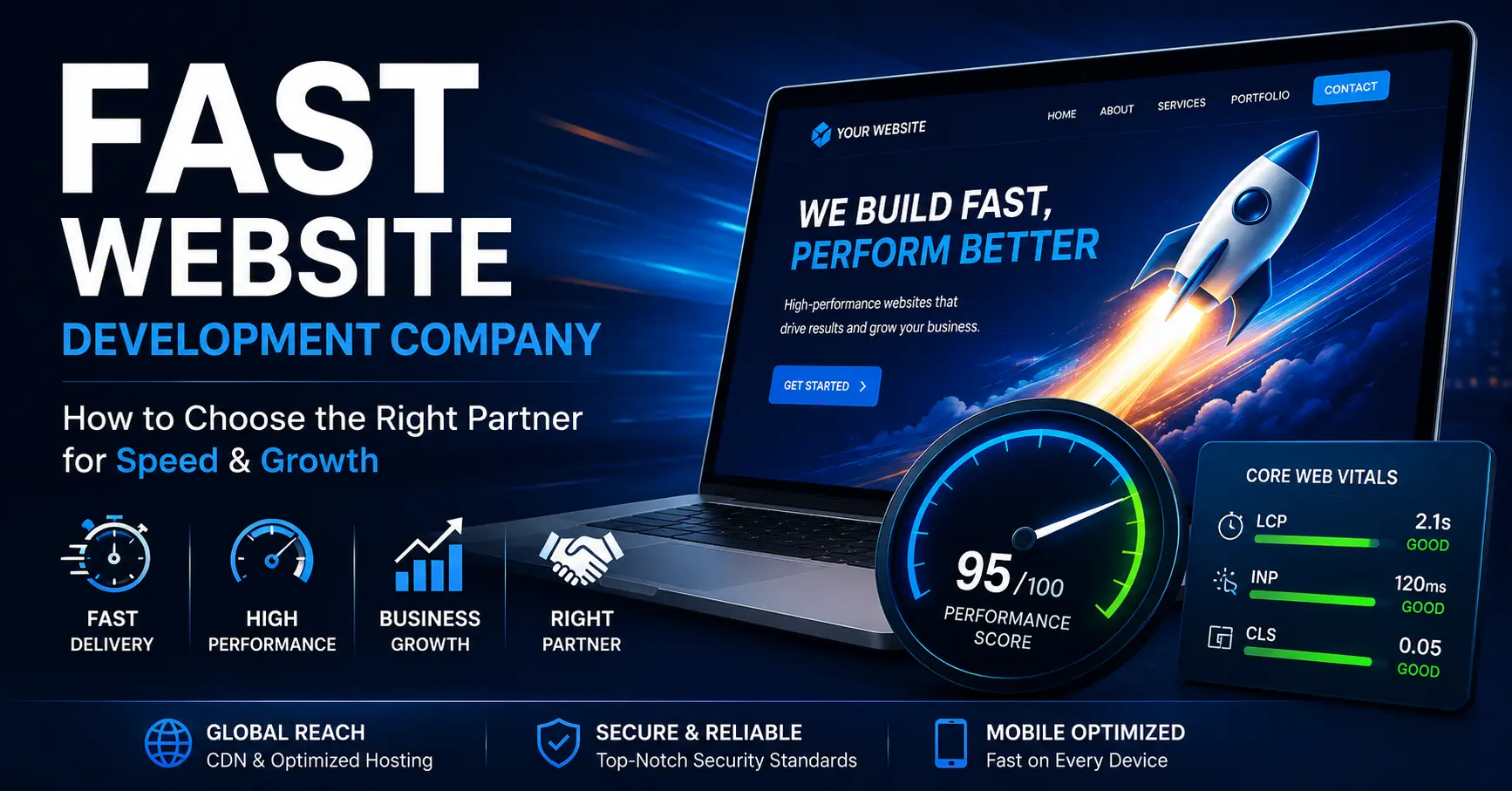
In today’s competitive digital landscape, choosing a Fast Website Development Company can make a significant difference in your online success. A fast-loading website not only improves user experience but also boosts search engine rankings, increases conversions, and reduces bounce rates. Whether you’re launching a new business website or upgrading an existing one, partnering with the right development company ensures your site is built efficiently and optimized for performance from day one. This guide explains what to look for in a fast website development company and how to choose the best partner for long-term growth.
Why Website Speed Is No Longer Optional
You’ve probably clicked on a site, waited a few seconds for it to load, and then hit the back button without even reading a word. You’re not alone. Research consistently shows that 53% of mobile users abandon websites that take longer than three seconds to load. That single stat captures why businesses today are racing to find a fast website development company — not just a good one.
But speed means two things when we talk about web development companies. First, it means how quickly the agency builds your site and gets it live. Second — and far more importantly — it means how fast your finished website loads for every visitor, on every device, in every corner of the world.
Both matter. Neither can be ignored.
What a “Fast Website Development Company” Actually Delivers
When a company markets itself as a fast website development agency, they should be delivering on two distinct promises:
1. Rapid Development Turnaround
Great agencies use proven processes, pre-built component libraries, and modern frameworks to cut project timelines without sacrificing quality. A brochure website shouldn’t take six months. A well-run agency can deliver a custom, production-ready site in two to eight weeks depending on complexity.
2. High-Performance Web Output
The site they hand you should score well on Google’s Core Web Vitals — the real-world performance metrics that directly influence your search rankings, user experience, and conversions. This means fast load times, minimal layout shift, and responsive interactions.
Most agencies talk about speed. The best ones can prove it with PageSpeed Insights scores, real client data, and transparent case studies.
The Business Case for Speed: What Slow Websites Actually Cost You
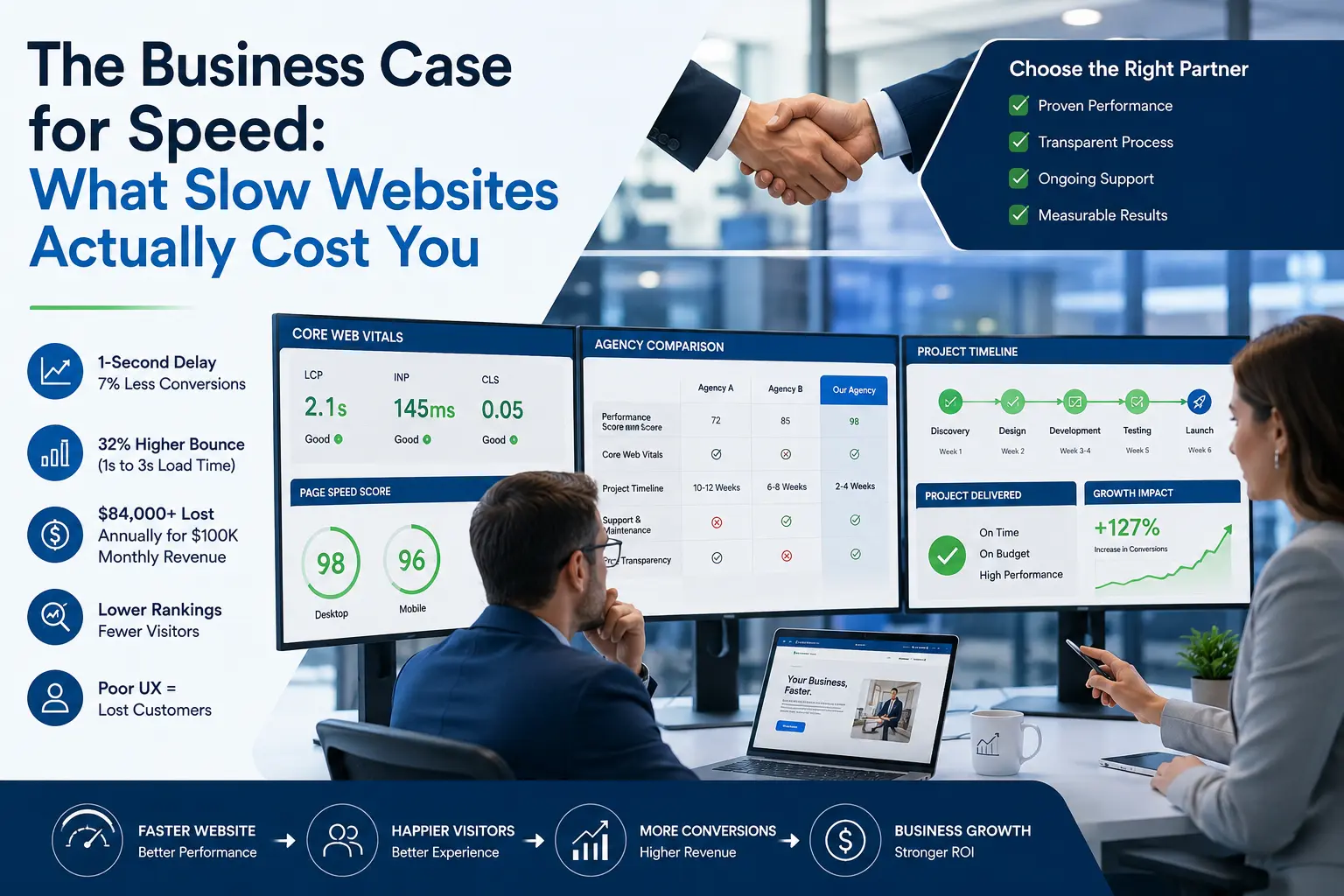
Before you start comparing agencies, it helps to understand just how significant website performance is to your bottom line. These aren’t abstract technical metrics — they translate directly into revenue.
A one-second delay in page load time can reduce your conversions by 7%. For a business generating $100,000 per month in online revenue, that single second costs $7,000 every month — $84,000 a year. Bounce rates increase by 32% as page load time goes from one second to three seconds, and by over 100% if it climbs to six seconds or more.
On the SEO side, Google has embedded page speed into its Core Web Vitals — a set of metrics measuring Largest Contentful Paint (LCP), Interaction to Next Paint (INP), and Cumulative Layout Shift (CLS). If your site doesn’t meet their thresholds, you lose ground to faster competitors in the search rankings, which compounds the traffic and conversion losses.
Speed isn’t a technical nicety. It’s a revenue driver.
The Core Web Vitals Every Fast Development Company Should Target
A competent fast website development company will build around these benchmarks from day one, not bolt them on afterward:
Largest Contentful Paint (LCP) — Under 2.5 seconds
This measures how long it takes for the main content block on a page to become visible. Slow LCP usually means unoptimized images, slow server response, or render-blocking JavaScript.
Interaction to Next Paint (INP) — Under 200 milliseconds
Replaced First Input Delay (FID) as the standard interaction metric. It measures how quickly the page responds when a user clicks, taps, or types. Heavy, unoptimized JavaScript is usually the culprit when this score suffers.
Cumulative Layout Shift (CLS) — Under 0.1
Measures visual stability — how much the page elements shift around as it loads. A high CLS score means users click the wrong button or lose their place on the page, which destroys trust and increases frustration.
As of early 2026, only around 51.8% of websites meet all three Core Web Vitals criteria. Hiring a development company that genuinely prioritizes these metrics puts you ahead of nearly half the web.
7 Technical Practices That Separate Fast Agencies from Average Ones
Not all web developers are performance engineers. Here’s what the best fast website development companies actually do differently:
1. Modern Image Formats and Lazy Loading
Top agencies use WebP or AVIF image formats, which reduce file sizes by up to 50% compared to JPEG or PNG without any visible quality loss. They also implement lazy loading so images only load when a user scrolls toward them — keeping initial page weight minimal.
2. Content Delivery Networks (CDNs)
A CDN distributes your website’s static assets — images, CSS, JavaScript — across servers worldwide. When someone in Lahore visits your site hosted in New York, a CDN serves the content from a nearby server instead. Cloudflare and AWS CloudFront are common choices. Without a CDN, every international visitor experiences a speed penalty.
3. Clean, Minified Code
Every unnecessary character in your CSS, JavaScript, and HTML slows download times. Professional agencies minify and compress all code before deployment, removing comments, whitespace, and unused code blocks. This reduces file sizes significantly without changing how the site looks or functions.
4. Server-Side Rendering and Static Site Generation
Modern JavaScript frameworks like Next.js, Gatsby, Astro, and Nuxt allow developers to pre-render pages on the server or at build time, so users receive ready-to-display HTML rather than waiting for JavaScript to build the page in their browser. This can shave hundreds of milliseconds off perceived load time.
5. Smart Caching Architecture
Caching stores copies of your pages so the server doesn’t have to rebuild them for every visitor. Well-implemented caching — at the browser, server, and CDN level — can make a site ten times faster and significantly reduce server costs. Agencies that skip this setup are leaving performance on the table.
6. Optimized Hosting Infrastructure
The hosting environment is the foundation of website speed. Serious development companies recommend and configure cloud infrastructure (AWS, Google Cloud, or specialized providers using NVMe storage and modern processors) rather than dropping client sites onto cheap shared hosting where resources are split across thousands of other websites.
7. Time to First Byte (TTFB) Optimization
TTFB is how long your server takes to start responding to a browser request. It should be under 600 milliseconds. This is influenced by server location, configuration, and hosting quality. Developers who don’t monitor TTFB often overlook the foundation of their performance problem entirely.
How to Choose a Fast Website Development Company Step by Step
Choosing the right fast website development company requires more than comparing prices. Following a structured approach can help you find a reliable partner that delivers both speed and quality.
Step 1: Define Your Website Goals
Start by identifying what you want your website to achieve. Whether it’s generating leads, selling products, or building brand awareness, clear goals will help you choose the right agency.
Step 2: Review Agency Portfolios
Examine previous projects to assess design quality, functionality, and overall user experience. Look for websites that are fast, modern, and relevant to your industry.
Step 3: Check Website Performance Scores
Use tools like Google PageSpeed Insights to evaluate websites built by the agency. A reputable company should have strong performance scores and optimized Core Web Vitals.
Step 4: Understand Their Development Process
Ask how the company manages projects, communicates with clients, and handles revisions. A clear process usually leads to faster delivery and better results.
Step 5: Compare Technologies and Hosting Solutions
Find out which frameworks, platforms, and hosting environments they recommend. Modern technologies often provide better speed, security, and scalability.
Step 6: Read Client Reviews and Testimonials
Customer feedback can reveal how well an agency performs in terms of communication, project delivery, and long-term support.
Step 7: Discuss Maintenance and Support
A website needs ongoing updates and monitoring. Choose a company that offers reliable post-launch support to keep your website running smoothly.
What to Look for When Hiring a Fast Website Development Company
With so many agencies claiming to build fast websites, here’s a practical checklist to separate the serious ones from the marketing noise:
Portfolio with Measurable Performance Data
Don’t just look at how sites look — run them through Google PageSpeed Insights yourself. A trustworthy agency should be proud to share live URLs and performance scores from client work.
Experience with Performance-First Frameworks
Ask about their technology stack. Agencies working with React, Next.js, Astro, or Jamstack architectures are generally more performance-conscious than those defaulting to outdated, plugin-heavy WordPress setups without any optimization layer.
Transparent Project Timelines
A fast development company should have a clear, repeatable process with defined milestones. Be wary of vague timelines. Good agencies will give you a realistic delivery schedule based on scope — not just tell you what you want to hear.
Post-Launch Performance Monitoring
The fastest site in the world will slow down over time if nobody is watching. Ask whether the agency offers ongoing monitoring, maintenance, and performance audits after launch. A website is not a set-and-forget asset.
Real Client Reviews and Case Studies
Look for reviews that specifically mention speed of delivery, communication, and the quality of the final product. Platforms like Clutch, UpCity, and Google Reviews give you unfiltered client perspectives. If an agency doesn’t have reviews, dig deeper before committing.
Clear Communication Throughout the Build
Slow communication is the most common reason projects drag on and go over budget. The best fast web development companies have structured feedback loops, project management systems, and a single point of contact — so nothing falls through the cracks.
Two Types of “Fast” — And Why You Need Both
Here’s something most articles miss: a fast website development company can fail you in one of two ways.
They can build your site quickly but deliver something slow — cutting corners on optimization to hit a deadline. Or they can obsess over performance tuning and take six months to launch, costing you the market opportunity speed was supposed to capture.
The agencies worth working with understand both dimensions. They use efficient processes (component libraries, established design systems, agile sprints) to move quickly during the build, and they apply performance engineering standards to make sure the final product loads fast.
Ask any prospective agency how they balance these two priorities. Their answer will tell you a lot.
Mobile Speed: Where Most Websites Fall Short
With over 60% of global web traffic now coming from mobile devices, mobile performance deserves its own section. The global average mobile page load time is 8.6 seconds — far above the 3-second benchmark that most users expect. In the United States and UK, averages are closer to 1.8–1.9 seconds, but that still means many sites are significantly underperforming.
A genuinely fast website development company builds mobile-first, not mobile-adapted. That means:
Designing layouts for small screens from the start, rather than squishing a desktop layout down. Using touch-friendly navigation and appropriately sized tap targets. Implementing Accelerated Mobile Pages (AMP) where applicable for content-heavy pages. Testing performance on actual mobile network conditions — not just desktop Wi-Fi.
On mobile, even a slightly slower load time destroys user trust and kills conversion rates. If an agency can’t show you strong mobile PageSpeed scores from their client portfolio, move on.
Questions to Ask a Fast Website Development Company Before Signing
These questions cut through the sales pitch and get to the reality of how an agency operates:
- Can you show me PageSpeed Insights scores for three recent client websites you built?
- What is your typical timeline from kickoff to launch for a project like mine?
- Which hosting infrastructure do you recommend and why?
- How do you handle Core Web Vitals optimization — is it built into your process or done post-launch?
- What does your post-launch support look like, and do you offer ongoing performance monitoring?
- How do you manage project communication, and who is my main point of contact?
- Do you use a component library or design system that speeds up your builds?
Any strong agency will answer these confidently and specifically. Vague or defensive responses are a warning sign.
Red Flags That Signal a “Fast” Agency Isn’t What They Claim
Speed is a popular marketing term that not every agency earns. Watch for these signs that an agency might not deliver what they promise:
They show you beautiful design portfolios but can’t produce performance data. They promise impossibly short timelines without scoping your project properly. They use outdated or bloated CMS setups without any performance optimization strategy. They have no client reviews, or reviews that focus only on aesthetics. Their own agency website loads slowly — run it through PageSpeed Insights before you contact them. They hand you a completed site but offer no training, documentation, or ongoing support.
The Right Fast Website Development Company for Your Business
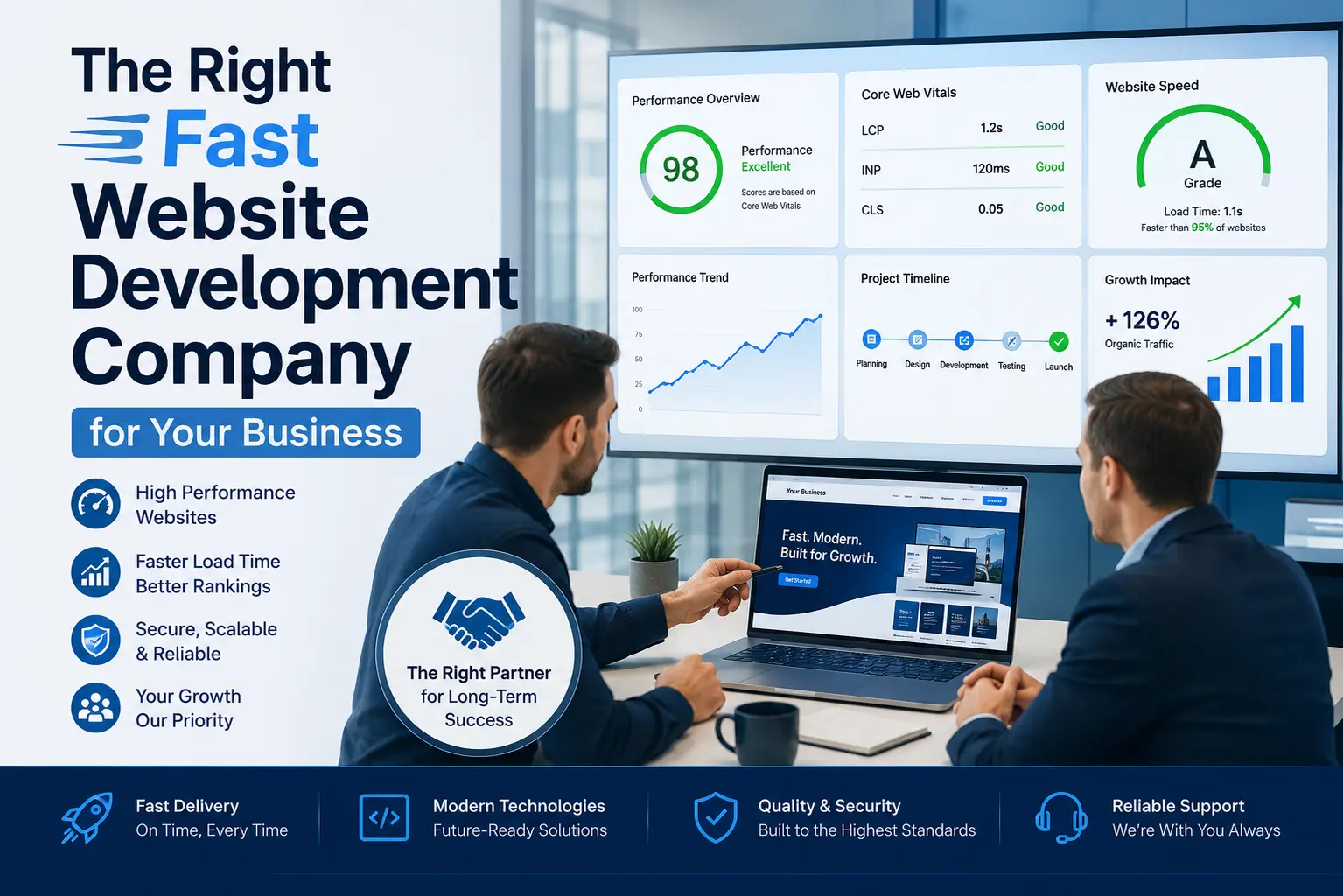
There is no single “best” fast website development company — the right fit depends on your industry, budget, and goals. A startup needing a lean marketing site has different requirements than an enterprise building a high-traffic eCommerce platform.
What stays constant is the standard: a company that builds fast, delivers efficiently, communicates clearly, and backs up their claims with data. Website performance is no longer a technical bonus — it’s a baseline requirement for competing online.
The businesses winning in search and conversions today are the ones that treated speed as a strategic investment, not an afterthought. The right development partner understands that. Find one who can prove it.
Last updated: June 2026
Frequently Asked Questions
What is a fast website development company?
A fast website development company specializes in building websites quickly while ensuring excellent speed, performance, and user experience for visitors.
Why is website speed important for business growth?
Website speed affects user experience, search engine rankings, bounce rates, and conversion rates. Faster websites typically generate better engagement and higher revenue.
How long does it take to develop a website?
The timeline depends on the project’s complexity. A simple business website may take 2–4 weeks, while custom or eCommerce websites can take 6–12 weeks or longer.
What technologies do fast website development companies use?
Many agencies use modern technologies such as React, Next.js, Astro, Vue.js, and optimized hosting environments to improve website performance.
How can I check if a website is fast?
You can use tools like Google PageSpeed Insights, Lighthouse, GTmetrix, and WebPageTest to analyze website speed and performance metrics.
Does website speed affect SEO?
Yes. Website speed is an important ranking factor because it influences Core Web Vitals, user experience, and overall search engine performance.
Conclusion
Choosing the right Fast Website Development Company is essential for businesses that want better website performance, improved search rankings, and higher conversion rates. A reliable development partner should not only deliver projects efficiently but also build websites that load quickly and provide an excellent user experience across all devices. By focusing on performance, modern technologies, and long-term support, businesses can create a strong online presence and stay ahead of the competition. Investing in a professional fast website development company today can lead to sustainable growth and greater success in the future.
You May Also Like It: