If you’ve ever been promised “page 1 rankings in 30 days” by a sketchy agency, you already know the anxiety that follows. Will it stick? Will Google penalize my site? Will I wake up one morning to find my traffic has collapsed?
Those fears are real — and they come from SEO done the wrong way.
White Hat SEO Services are the opposite of that. They’re the strategies Google actually wants you to use: building real authority, earning genuine backlinks, creating content that helps people, and optimizing your site so it’s fast, clean, and easy to use. The results take a little longer to arrive, but when they do, they hold.
This guide explains exactly what white hat SEO services include, why they matter in 2026, and how to identify a provider who’s actually doing it right.
What Are White Hat SEO Services?
White hat SEO refers to any search engine optimization technique that follows Google’s official Search Essentials guidelines and prioritizes the user’s experience over algorithm manipulation.
In plain English: you rank higher because your website genuinely deserves to rank higher — not because you gamed the system.
The term “white hat” comes from old Western movies, where the good guys wore white hats. It’s a contrast to “black hat SEO,” which uses deceptive tactics like buying links, keyword stuffing, cloaking, and hidden text to force rankings. Black hat tactics can work in the short term, but as Google’s algorithms grow more sophisticated, they are increasingly likely to fail — and when they do, the penalties can be devastating.
White hat SEO services are:
- Fully compliant with Google’s guidelines
- Focused on user experience and real value
- Built for long-term, sustainable ranking growth
- Transparent and easy to explain to clients or stakeholders
- Resilient to algorithm updates
Why White Hat SEO Matters More Than Ever in 2026
Google’s March 2024 core update — widely considered the largest in the search engine’s history — integrated the Helpful Content System directly into its core ranking algorithm. This fundamentally changed the game. Thin, AI-spun content designed purely to rank can now be identified and demoted at scale.
Add to this the rise of AI Overviews in search results, which now appear in over 13% of all queries, and you have a landscape where trust, authority, and genuine helpfulness have never mattered more.
Sites that cut corners with black hat or gray hat tactics are increasingly finding themselves unable to recover from updates. Sites that have consistently followed white hat practices, on the other hand, tend to weather algorithm changes and — in some cases — even benefit from them, because their competitors get knocked down.
The bottom line: white hat SEO isn’t just the ethical choice. In 2026, it’s the only reliably effective one.
Core White Hat SEO Services Explained
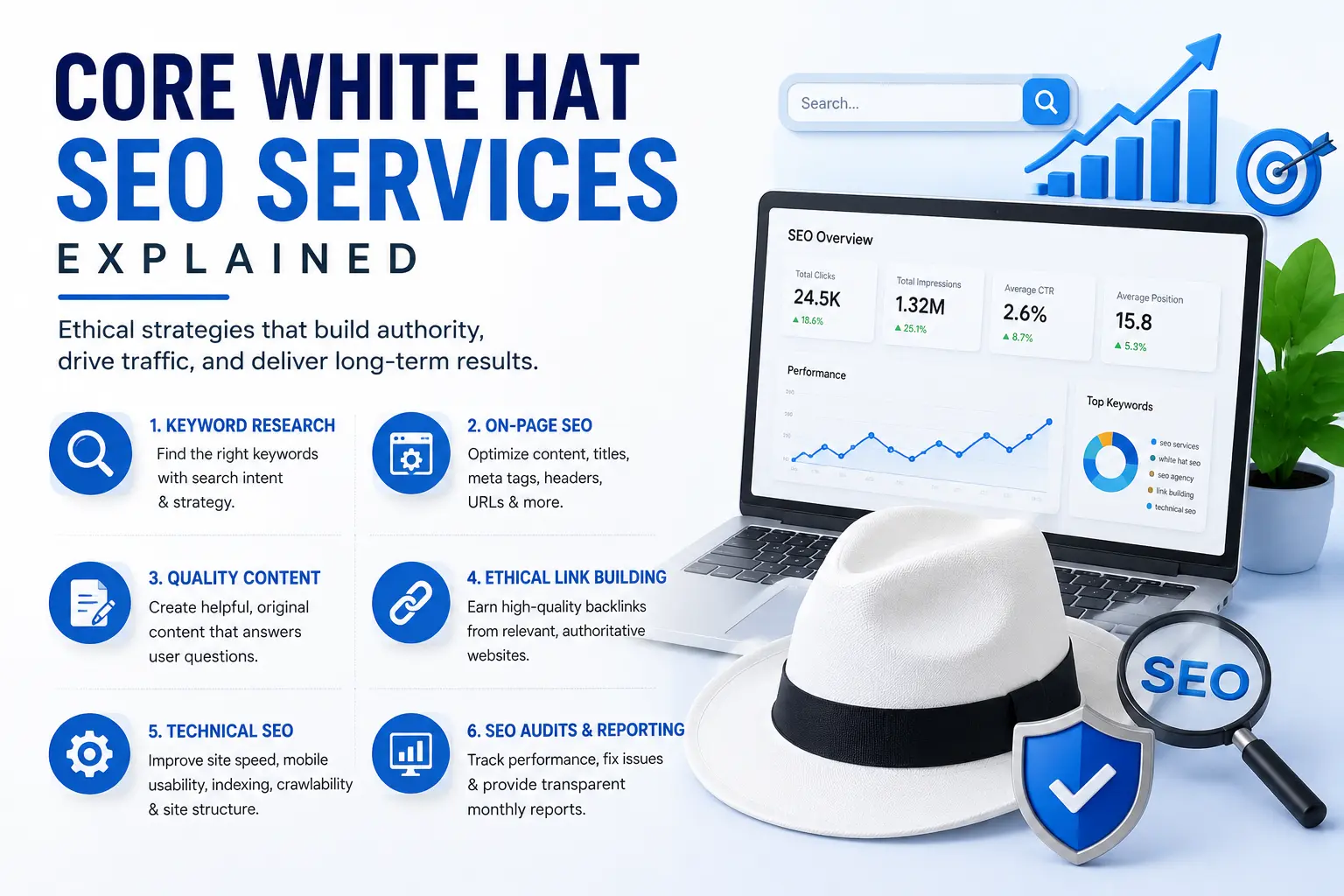
A legitimate white hat SEO agency will offer a combination of the following services. Each one works together — neglect one area and the whole strategy suffers.
1. In-Depth Keyword Research and Strategy
Everything starts with understanding what your audience actually searches for. This isn’t about finding the highest-volume keywords and stuffing them into your pages. It’s about understanding search intent — why someone is typing a query — and matching your content to what they genuinely need.
Good keyword research identifies:
- High-intent keywords that attract visitors ready to buy or take action
- Long-tail keywords with lower competition but strong conversion potential
- Informational keywords that bring in top-of-funnel traffic and build brand awareness
- Semantic variations and related terms that help establish topical authority
Tools like Semrush, Ahrefs, and Google Search Console are standard. What separates an expert from an amateur is knowing which data points matter and how to build a strategy around them — not just a list of keywords.
2. On-Page SEO Optimization
Once you know your keywords, you need to use them correctly — and that’s more nuanced than most people realize.
On-page SEO covers:
- Title tags — Your primary keyword should appear here, ideally near the beginning. Keep titles under 60 characters.
- Meta descriptions — Not a direct ranking factor, but they directly impact click-through rate. Write them for humans, keep them under 155 characters.
- Header tags (H1, H2, H3) — Structure your content logically. One H1 per page, with supporting H2s and H3s that incorporate semantic keywords naturally.
- URL structure — Short, descriptive, keyword-rich URLs with hyphens between words. Avoid dates or random numbers.
- Image alt text — Google cannot “see” images. Alt text tells search engines what an image depicts, which improves both SEO and accessibility.
- Internal linking — Linking between relevant pages on your site helps Google understand your site structure, distributes link authority, and keeps users engaged longer.
- Keyword placement — Use your primary keyword in the first 100 words, in at least one H2, and naturally throughout the body. Never stuff.
3. High-Quality Content Creation
Content is the foundation of white hat SEO. Without content worth ranking, none of the other tactics matter.
Google’s systems are designed to surface “original, helpful content that leaves people feeling they’ve had a satisfying experience.” That means content needs to genuinely answer the question someone came to your page with — not dance around it, pad with filler, or regurgitate what everyone else has already said.
High-performing content in 2026 typically:
- Addresses a specific search intent clearly and directly
- Demonstrates real expertise — not generic advice, but specific, experience-backed insight
- Goes beyond the obvious — covers angles, nuances, and questions competitors have missed
- Includes original data, examples, or case studies where possible
- Is structured for readability — short paragraphs, subheadings, bullet points where appropriate
One technique worth understanding is the Skyscraper Method: research the top-ranking content for your target keyword, identify what it’s missing or where it falls short, then create something demonstrably more thorough, up-to-date, and useful. This isn’t copying — it’s competing.
Topic clusters are another powerful content structure. Instead of publishing standalone articles on random topics, you build a “pillar page” (a comprehensive guide on a broad topic) supported by several “cluster pages” (focused articles on specific subtopics), all internally linked. This signals deep topical authority to Google and helps your entire cluster rank — not just individual pages.
4. Technical SEO
Great content on a broken website won’t rank. Technical SEO ensures that Google can find, crawl, and understand your pages — and that users have a fast, smooth experience when they arrive.
Key technical SEO areas include:
- Site speed and Core Web Vitals — Google uses Core Web Vitals (Largest Contentful Paint, Interaction to Next Paint, Cumulative Layout Shift) as ranking signals. Slow pages lose both rankings and users.
- Mobile optimization — Google uses mobile-first indexing, meaning it primarily uses the mobile version of your site for ranking. If your site is clunky on phones, your rankings will reflect that.
- Crawlability and indexation — Your robots.txt file, sitemap.xml, and internal link structure should guide Googlebot clearly to your most important pages.
- HTTPS security — An SSL certificate is a basic trust signal. Any site still running on HTTP in 2025 is leaving rankings on the table.
- Schema markup (structured data) — Helps Google understand the context of your content and can unlock rich results (star ratings, FAQ dropdowns, etc.) in search results.
- Fixing crawl errors — Broken links, 404 errors, redirect chains, and duplicate content all waste crawl budget and confuse Google.
- Site architecture — A well-structured site allows any page to be reached within three clicks from the homepage. Flat, logical structure improves both user experience and crawlability.
5. Ethical Link Building
Backlinks remain one of Google’s most important ranking factors. But not all links are equal — and earned links in white hat SEO are dramatically different from purchased or manipulated ones.
White hat link building is about earning links because your content or brand genuinely deserves them. Key methods include:
- Guest posting — Writing high-quality articles for reputable sites in your industry, with a relevant backlink in return.
- Digital PR — Pitching original data, research, or expert commentary to journalists and bloggers. Services like HARO (Help a Reporter Out) and Qwoted connect you with journalists looking for sources.
- The Skyscraper Technique — Creating superior content on topics where your competitors have earned links, then reaching out to sites that linked to the inferior content.
- Broken link building — Finding broken links on relevant websites and suggesting your content as a replacement.
- Editorial backlinks — Links that come naturally when your content is cited because it’s genuinely the best resource on a topic.
- Content outreach — Proactively promoting your best content to relevant publishers, bloggers, and industry websites.
What separates white hat link building from black hat is that every link is earned through merit, relevance, and relationship — never bought, never manufactured through private blog networks (PBNs), and never generated with spammy automation.
6. Local SEO
For businesses serving a specific geographic area, local SEO is one of the highest-ROI services available. It involves optimizing your presence in Google’s local search results — both the Map Pack and organic results.
Core local SEO services include:
- Google Business Profile optimization — Complete, accurate, regularly updated profile with photos, reviews, correct categories, and consistent NAP (Name, Address, Phone).
- Local keyword targeting — Incorporating city- and region-specific keywords into your pages and metadata.
- Citation building — Consistent listings across reputable directories (Yelp, Bing Places, Apple Maps, industry-specific directories).
- Review management — Encouraging genuine customer reviews and responding to them professionally.
- Local content — Blog posts and landing pages that address local topics, events, or searches.
7. SEO Audits and Ongoing Reporting
A white hat SEO engagement should never be a “set it and forget it” situation. Regular audits catch technical issues before they damage rankings, and transparent reporting keeps you informed about what’s working and why.
Good SEO reporting covers:
- Keyword ranking changes over time
- Organic traffic trends (via Google Analytics)
- Backlink profile health (new links earned, toxic links disavowed)
- Core Web Vitals scores
- Conversion rates from organic traffic — because traffic without revenue is just a vanity metric
Step-by-Step White Hat SEO Process for Sustainable Rankings
White hat SEO services work best when they follow a clear process instead of random actions. A proper step-by-step strategy helps improve rankings safely, build trust with Google, and create long-term organic growth.
1. Start With a Complete SEO Audit
The first step is to check the current condition of the website. This includes reviewing technical issues, page speed, mobile usability, broken links, duplicate content, indexation problems, and existing keyword rankings. A detailed audit helps identify what is stopping the website from performing better in search results.
2. Research the Right Keywords
After the audit, keyword research is done to understand what the target audience is searching for. Instead of choosing only high-volume keywords, white hat SEO focuses on search intent, long-tail keywords, commercial terms, and informational queries that can bring relevant traffic.
3. Analyze Competitors
Competitor analysis helps reveal what top-ranking websites are doing well. This includes studying their content structure, backlinks, keyword usage, page experience, and topic coverage. The goal is not to copy competitors but to create better, more helpful, and more complete content.
4. Optimize On-Page SEO
On-page SEO includes improving title tags, meta descriptions, headings, URLs, image alt text, internal links, and keyword placement. Every page should be easy for both users and search engines to understand. The main keyword should be used naturally without keyword stuffing.
5. Create Helpful and High-Quality Content
Content is the foundation of white hat SEO. The website should publish original, useful, and well-structured content that answers real user questions. Strong content should include clear explanations, examples, updated information, and practical value.
6. Fix Technical SEO Issues
Technical SEO ensures that search engines can crawl, index, and understand the website properly. This step includes improving Core Web Vitals, mobile responsiveness, HTTPS security, sitemap setup, robots.txt, schema markup, redirects, and crawl errors.
7. Build Ethical Backlinks
White hat link building focuses on earning backlinks from relevant and trustworthy websites. This can be done through guest posting, digital PR, broken link building, expert quotes, useful resources, and content outreach. The goal is to earn links naturally, not buy spammy links.
8. Improve Local SEO If Needed
For local businesses, Google Business Profile optimization is important. This includes adding accurate business details, service areas, photos, reviews, local keywords, and consistent NAP information across directories. Local SEO helps businesses appear in map results and nearby searches.
9. Track Performance and Reports
SEO performance should be monitored regularly. Important metrics include keyword rankings, organic traffic, backlinks, conversions, indexed pages, Core Web Vitals, and user engagement. Monthly reports help show what is working and what needs improvement.
10. Keep Updating and Improving
White hat SEO is not a one-time task. Content should be updated, technical issues should be checked, and new opportunities should be found regularly. Continuous improvement helps the website stay competitive and protect rankings during Google updates.
White Hat SEO vs. Black Hat SEO vs. Gray Hat SEO
Understanding the differences helps you evaluate any agency you’re considering.
| White Hat | Gray Hat | Black Hat | |
|---|---|---|---|
| Approach | Follows Google guidelines | Bends guidelines | Violates guidelines |
| Risk | Minimal | Moderate | High |
| Timeline | 3–12 months | Faster short-term | Very fast, then crash |
| Durability | Long-lasting | Unpredictable | Often collapses with updates |
| Examples | Quality content, earned links | Aggressive link exchanges | Bought links, cloaking, PBNs |
Gray hat SEO is a common trap. An agency might use mostly ethical techniques but supplement them with a few shady tactics to speed things up. The problem is that Google’s algorithms keep getting smarter, and what passes today may be penalized in the next update.
If you can’t proudly explain your SEO strategy to a room full of people — including a Google engineer — it’s probably not white hat.
What to Look for When Hiring a White Hat SEO Agency
Not every agency that claims to be “white hat” actually is. Here’s how to tell the difference.
Green flags:
- They explain their methods clearly and in plain language
- They ask about your business goals before pitching tactics
- They set realistic timelines (sustainable results typically take 3–6 months to begin showing)
- They provide detailed monthly reports with real data
- They can point to case studies with verifiable results
Red flags:
- They guarantee specific rankings (no ethical SEO can guarantee a #1 position)
- Their pricing is unusually low with promises of fast results
- They won’t explain how they build links
- They talk about “tricks” or “hacks” rather than strategy
- They never mention content quality or user experience
How Long Does White Hat SEO Take?
This is the most common question — and the honest answer is: it depends, but expect 3 to 6 months before you see significant movement, and 6 to 12 months to reach competitive rankings.
The timeline depends on:
- Your domain’s existing authority — A newer domain with few existing links will take longer than an established site.
- The competitiveness of your keywords — Ranking for “best pizza in [small city]” is very different from ranking for “best CRM software.”
- Content quality and publishing frequency — More high-quality content, published consistently, accelerates results.
- Technical health — A site with serious crawl errors or speed issues will need those fixed before rankings improve.
White hat SEO is not a sprint. It’s an investment. But the rankings it builds are far more resilient to algorithm changes, and the traffic it generates compounds over time rather than evaporating overnight.
White Hat SEO and E-E-A-T
Google’s quality evaluator guidelines emphasize E-E-A-T: Experience, Expertise, Authoritativeness, and Trustworthiness. This framework, originally developed for assessing content quality, now deeply influences how Google’s algorithms evaluate and rank pages.
White hat SEO is, at its core, an E-E-A-T strategy. Every major tactic — high-quality content, authoritative backlinks, transparent author credentials, technical credibility — directly builds one of these four signals.
To improve your E-E-A-T:
- Include real author bios with credentials and experience on your content
- Cite authoritative sources (and earn citations from them)
- Display trust signals: testimonials, case studies, certifications, awards
- Keep content accurate and updated — outdated information erodes trust
- Use first-person, experience-backed writing where appropriate — Google can increasingly detect whether content reflects real expertise
The Hidden Edge: Insights Often Missed
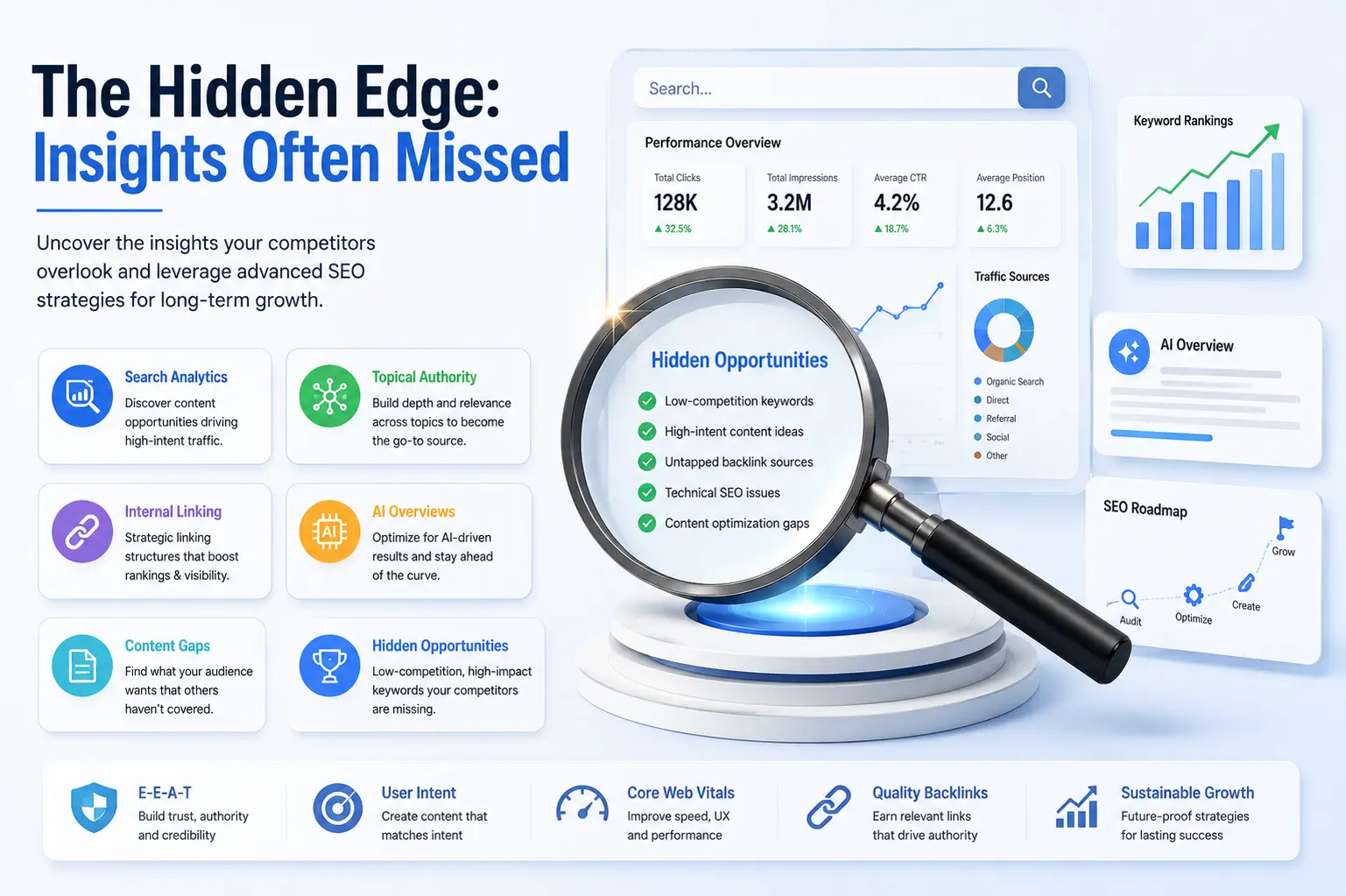
Most articles on white hat SEO services cover the basics — content, links, technical SEO. Here are a few areas where an extra investment pays dividends that most businesses overlook:
1. Topical authority over individual keywords. Ranking for one keyword is useful. Owning a topic — having Google trust your site as the go-to resource for an entire subject area — is transformative. Build it through topic clusters, consistent publishing, and linking all your related content together.
2. Search intent alignment. You can have the best content in the world, but if it doesn’t match what users expected when they typed their query, your bounce rate will tell Google it doesn’t belong on page one. Always confirm the dominant intent behind a keyword (informational, navigational, commercial, transactional) and match your content format accordingly.
3. YouTube and video SEO. A blog post on a topic and a YouTube video on the same topic can both rank — sometimes in the same SERP. White hat SEO in 2026 increasingly means repurposing content into video, optimizing video metadata, and treating YouTube as a second search engine worth ranking on.
4. Answer Engine Optimization (AEO). With AI Overviews now appearing in over 13% of queries, optimizing to be cited within those AI-generated answers is becoming a legitimate and valuable traffic strategy. Brands cited in AI Overviews earn significantly more clicks than those that aren’t. This requires clear, direct, well-structured content that answers questions concisely — exactly what white hat SEO produces.
5. Internal linking strategy. Most sites treat internal linking as an afterthought. In reality, a thoughtful internal linking structure does three things: it tells Google which pages are most important, distributes link equity from authoritative pages to newer ones, and keeps users navigating your site longer — which is a positive behavioral signal. Aim for 2–3 contextually relevant internal links within the first 300 words of each new piece.
Frequently Asked Questions
Is white hat SEO worth it for small businesses?
Absolutely — arguably more so than for large enterprises. Large brands often rank partly on brand recognition alone. Small businesses compete almost entirely on content quality, local relevance, and earned authority, all of which are white hat strengths.
Can I do white hat SEO myself?
Yes, to a point. On-page optimization, content creation, and basic technical fixes are learnable. Link building at scale and comprehensive technical audits typically require professional expertise and tools.
How much do white hat SEO services cost?
Pricing varies widely based on scope, competition, and agency expertise. Entry-level packages from reputable providers typically start around $500–$1,000/month. Mid-market campaigns run $1,500–$5,000/month. Full-service, high-competition engagements can exceed $10,000/month.
What’s the difference between white hat SEO and content marketing?
They’re closely related but not identical. Content marketing is the creation and distribution of valuable content to attract an audience. White hat SEO includes content but also covers technical optimization, link building, and search-specific strategy. In practice, the best white hat SEO programs are deeply integrated with content marketing.
Final Thoughts
White hat SEO services aren’t just the “safe” option — they’re the smart one. In a search environment where Google is increasingly capable of identifying and rewarding genuine quality, the sites that win are the ones that have actually earned it.
The tactics that worked in 2012 — stuffing keywords, buying links, spinning thin content — are either ineffective or actively dangerous now. The fundamentals of white hat SEO, on the other hand, have only become more important: understand your audience, create content that genuinely helps them, build a website that works flawlessly, and earn the trust of other authoritative sites in your space.
Invest in white hat SEO services and you’re not just chasing rankings. You’re building an asset that compounds over time — more visibility, more authority, more trust, and more revenue — with far less risk than any shortcut could ever promise.
You May Also Like It: