If you’ve been searching for ways to get your small business found on Google, you’ve likely come across the term “SEO packages.” But with prices ranging from $300 to $5,000 a month — and agencies promising everything from “first-page rankings in 30 days” to vague guarantees of “more traffic” — it can be genuinely hard to know what you’re actually paying for, or whether it’s worth it at all.
This guide cuts through the noise. We’ll explain exactly what Small Business SEO Packages include, what they cost, what real results look like, and — crucially — what separates a package that grows your business from one that drains your budget without moving the needle.
What Is a Small Business SEO Package?
An SEO package is a bundled set of search engine optimization services sold by an agency or consultant, typically on a monthly retainer basis. Rather than billing hourly for individual tasks, providers group key SEO activities together at a fixed monthly price.
For small businesses, these packages are designed to be more focused and cost-effective than the comprehensive campaigns built for enterprise clients. They typically concentrate on the specific tactics that matter most for smaller websites competing in local or niche markets: ranking in Google for relevant searches, showing up in Google Maps, and attracting customers who are actively looking for what you sell.
The core idea is simple: your website earns more organic visibility in search engines, which brings in more qualified visitors, which converts into more leads and sales — without the recurring cost of paid advertising.
Why SEO Matters More Than Ever for Small Businesses
Before diving into packages, it helps to understand what’s at stake.
Studies consistently show that the vast majority of consumers research products and services online before making a purchase decision — and most of those searches start on Google. When someone types “plumber near me” or “best bakery in [your city],” the businesses that appear at the top of those results capture the lion’s share of clicks, calls, and foot traffic.
Unlike pay-per-click advertising (Google Ads), which stops working the moment you stop paying, SEO builds compounding value over time. A well-ranked page can generate traffic and leads for months or years. That’s why even small businesses with modest marketing budgets are increasingly treating SEO as a non-negotiable investment rather than an optional expense.
What’s Included in a Small Business SEO Package?
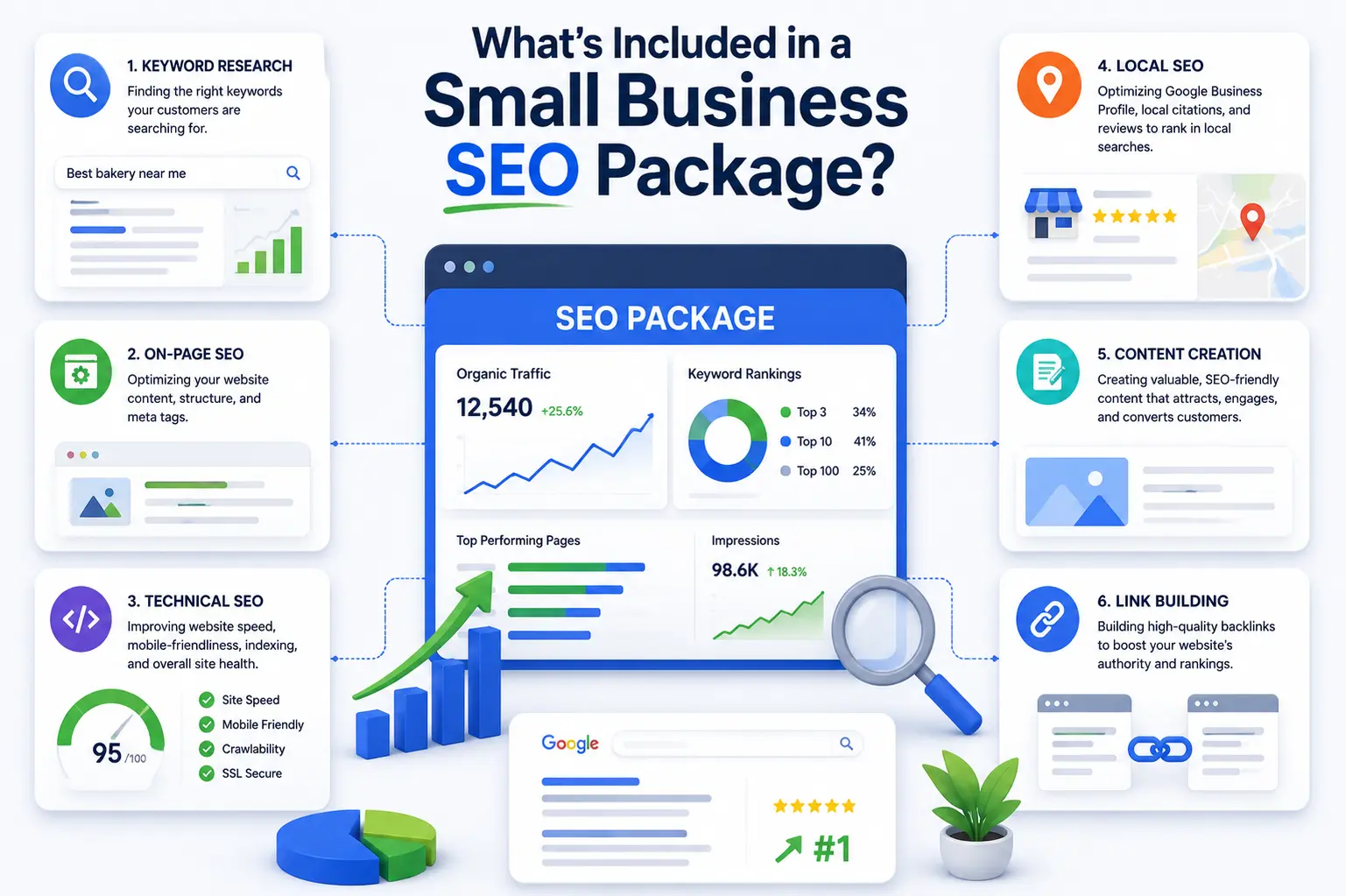
Not all packages are created equal, but any reputable small business SEO package should include these core components:
1. Keyword Research and Strategy
Before optimizing anything, an SEO provider needs to understand exactly what your potential customers are searching for. Good keyword research goes beyond obvious terms — it uncovers the specific phrases with genuine commercial intent that are most likely to drive qualified traffic and conversions. This foundation shapes everything else in the campaign.
2. On-Page SEO Optimization
On-page SEO means making sure each page of your website is structured in a way that search engines can understand and reward. This includes optimizing title tags and meta descriptions, using heading tags correctly, improving internal linking, adding structured data (schema markup), and ensuring your target keywords appear naturally in the right places. It’s not about stuffing keywords — it’s about clarity and relevance.
3. Technical SEO
A great-looking website that loads slowly, has broken links, or can’t be properly crawled by Google is an invisible website. Technical SEO addresses the behind-the-scenes factors that affect how search engines access and rank your site: page speed, mobile-friendliness, crawlability, indexation, Core Web Vitals, and HTTPS security. Many small business websites have fixable technical issues that are silently suppressing rankings.
4. Local SEO (Critical for Most Small Businesses)
If you serve customers in a specific geographic area, local SEO should be front and center in your package. This includes:
- Google Business Profile (GBP) optimization: Your GBP listing is often the first thing potential customers see. A well-optimized profile with accurate information, photos, service descriptions, and regular posts can dramatically improve your visibility in Google Maps and the local “3-pack” results.
- Local citation building: Citations are mentions of your business name, address, and phone number (NAP) on directories like Yelp, Yellow Pages, and industry-specific platforms. Consistency across these listings builds trust with Google and can improve local rankings.
- Review management: Encouraging and responding to Google reviews builds social proof and sends positive signals to search algorithms.
5. Content Creation
Consistent, high-quality content is one of the most powerful SEO levers available to small businesses. Whether it’s blog posts answering common customer questions, service pages that target specific search terms, or location-specific landing pages, content gives Google more reasons to rank your site — and gives potential customers more reasons to trust you. Look for packages that include at least 2–4 pieces of content per month.
6. Link Building
Backlinks — links from other reputable websites pointing to yours — remain one of Google’s most important ranking signals. Quality link building is time-intensive and requires real relationship-building or content worthy of being cited. Be wary of packages that promise large volumes of cheap links; these can trigger Google penalties that are expensive to recover from.
7. Reporting and Analytics
You should always know exactly what your SEO investment is doing. A good package includes monthly reporting that covers keyword ranking movements, organic traffic trends, leads or conversions attributed to SEO, and a clear explanation of what work was done. Transparency here is non-negotiable.
Small Business SEO Package Pricing: What to Expect in 2026
Pricing varies significantly based on your industry’s competitiveness, your geographic market, the agency’s expertise, and the scope of services included. Here’s a realistic breakdown:
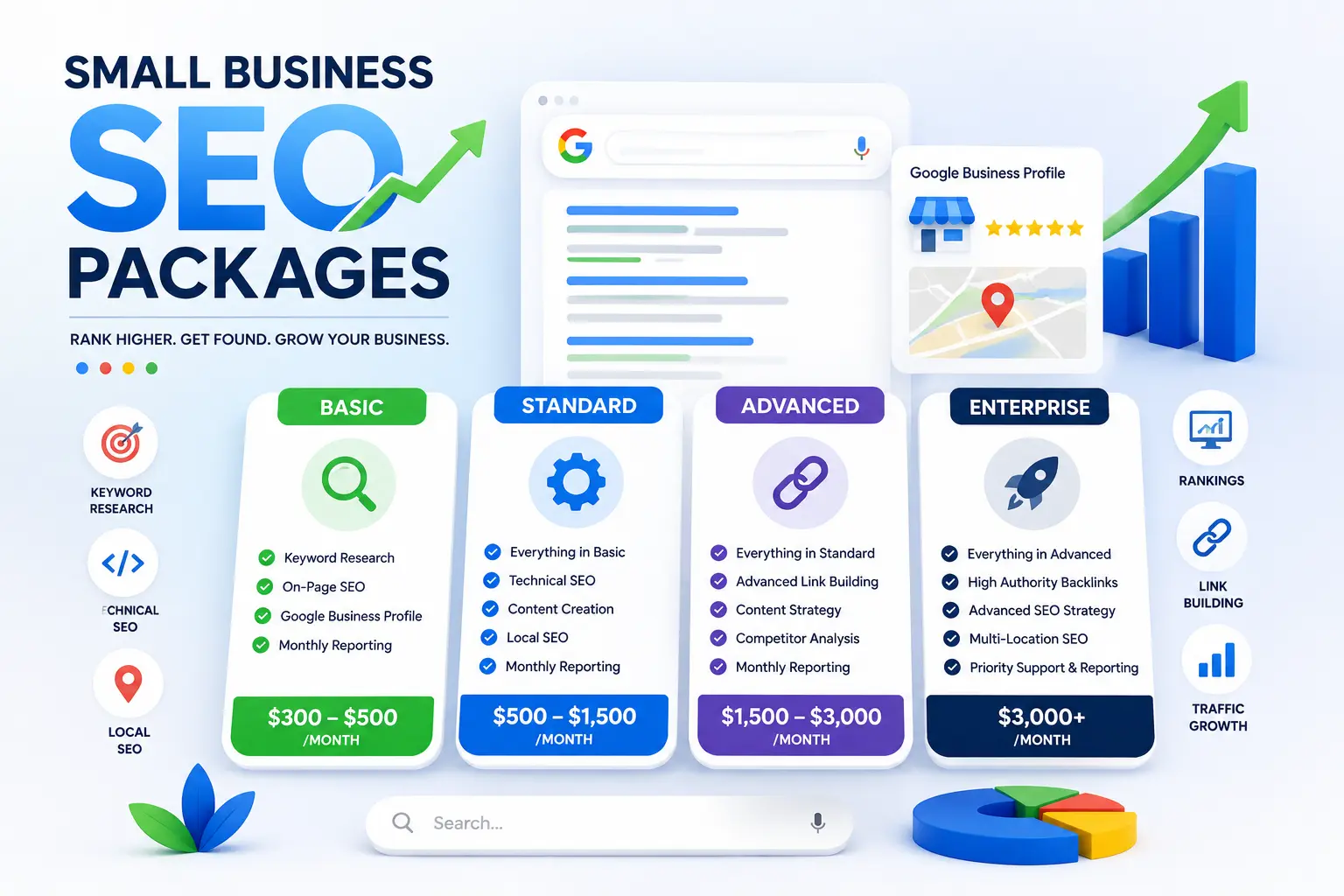
| Package Type | Monthly Cost | Best For |
|---|---|---|
| Basic SEO | $300-$500 | New Businesses |
| Standard SEO | $500-$1500 | Local Businesses |
| Advanced SEO | $1500-$3000 | Competitive Markets |
| Enterprise SEO | $3000+ | Multi-location Brands |
$300–$500/month — Entry-level / Local Basic
Typically covers Google Business Profile setup and optimization, basic local citation management, and minimal reporting. This tier can work for very small businesses in low-competition markets but usually lacks the ongoing content and link building needed for sustained growth.
$500–$1,500/month — Small Business Core
The most common range for genuine small business SEO. Expect on-page optimization, keyword research, local SEO, regular content creation, basic link building, and monthly reporting. This is where you start seeing real, compounding results over 6–12 months.
$1,500–$3,000/month — Competitive Markets
Suitable for businesses in more competitive industries or cities, or those targeting regional rather than purely local audiences. Includes more aggressive content production, stronger link building efforts, and deeper technical SEO work.
$3,000–$5,000+/month — High-Competition or Multi-Location
For businesses competing in saturated markets (law, finance, real estate, healthcare) or those with multiple locations requiring separate local SEO strategies.
One important note: price alone is not a measure of quality. A $500/month package from a specialized, experienced provider can outperform a $2,000/month package from an agency that churns clients and automates everything. Focus on deliverables, transparency, and track record.
The Timeline: When Will You See Results?
This is where many small business owners get frustrated — and where some agencies are less than honest.
SEO is not a quick-fix strategy. Here’s a realistic timeline:
- Months 1–2: Setup, audit, technical fixes, keyword research, GBP optimization. Little visible change in rankings yet.
- Months 3–4: Early movement on long-tail, lower-competition keywords. Organic traffic may start to tick upward.
- Months 6–9: Meaningful ranking improvements for your primary target keywords. Noticeable increase in organic leads.
- Months 12+: Compounding returns. Pages that have been earning authority and links begin to hold strong positions. This is where SEO’s ROI really opens up.
Anyone promising first-page rankings in 30 days should be treated with serious skepticism. Google’s algorithm takes time to trust new or improved content, and sustainable rankings require consistent effort — not shortcuts.
Red Flags to Watch Out For
The SEO industry has more than its share of bad actors. Here are the warning signs that should make you walk away:
Guaranteed #1 rankings. No reputable SEO provider can guarantee specific rankings. Google’s algorithm is their domain, not ours.
Extremely cheap packages ($99–$200/month). Effective SEO requires real human expertise and time. At these price points, providers are typically selling automated link schemes or templated work that can harm your site.
No clear list of deliverables. If an agency can’t tell you specifically what they’ll do each month, that’s a serious problem.
Vague or no reporting. If you can’t see exactly what’s happening with your rankings and traffic, you have no way to evaluate the ROI.
Lock-in contracts with no exit clause. Reputable agencies are confident enough in their work to offer month-to-month arrangements or reasonable notice periods.
Promises of instant results. If it sounds too good to be true, it is.
SEO Articles Get Wrong (And What You Actually Need to Know)
Most comparison articles in this space list the same surface-level tips. Here are three things that don’t get mentioned enough:
1. Industry and local competition matter more than package tier. A $600/month package for a florist in a rural market may outperform a $2,000 package for a personal injury lawyer in a major city — not because the service is better, but because the competitive landscape is entirely different. Before budgeting for SEO, do a realistic assessment of who you’re competing against in search results.
2. Your website’s starting condition dramatically affects timelines and costs. If your site has years of technical debt — slow load times, broken pages, poor mobile experience, duplicate content — a significant portion of your early SEO investment will go toward fixing these issues before growth can begin. Getting a technical audit before signing any contract can help you understand what you’re actually starting with.
3. E-E-A-T signals are now central, not supplementary. Google’s quality guidelines increasingly reward Experience, Expertise, Authoritativeness, and Trustworthiness. For small businesses, this means your website should feature real team bios with credentials, genuine customer reviews, case studies or before/after examples, and content that clearly demonstrates firsthand knowledge of your industry. A good SEO package in 2026 should be building these signals into your content strategy — not just targeting keywords.
Questions to Ask Before Signing With an SEO Agency
Before committing to any package, get clear answers to these questions:
- What specific deliverables will I receive each month?
- Who will actually be doing the work — in-house team or outsourced contractors?
- How do you measure and report on results?
- Can you share examples of results you’ve achieved for businesses similar to mine?
- What does your link-building approach look like, specifically?
- What happens to the work you’ve done if I cancel?
- What is the contract length and cancellation policy?
A good agency will answer all of these questions openly and confidently. Evasive or vague answers are a signal to keep looking.
Local SEO vs Broader SEO: Which Does Your Business Need?
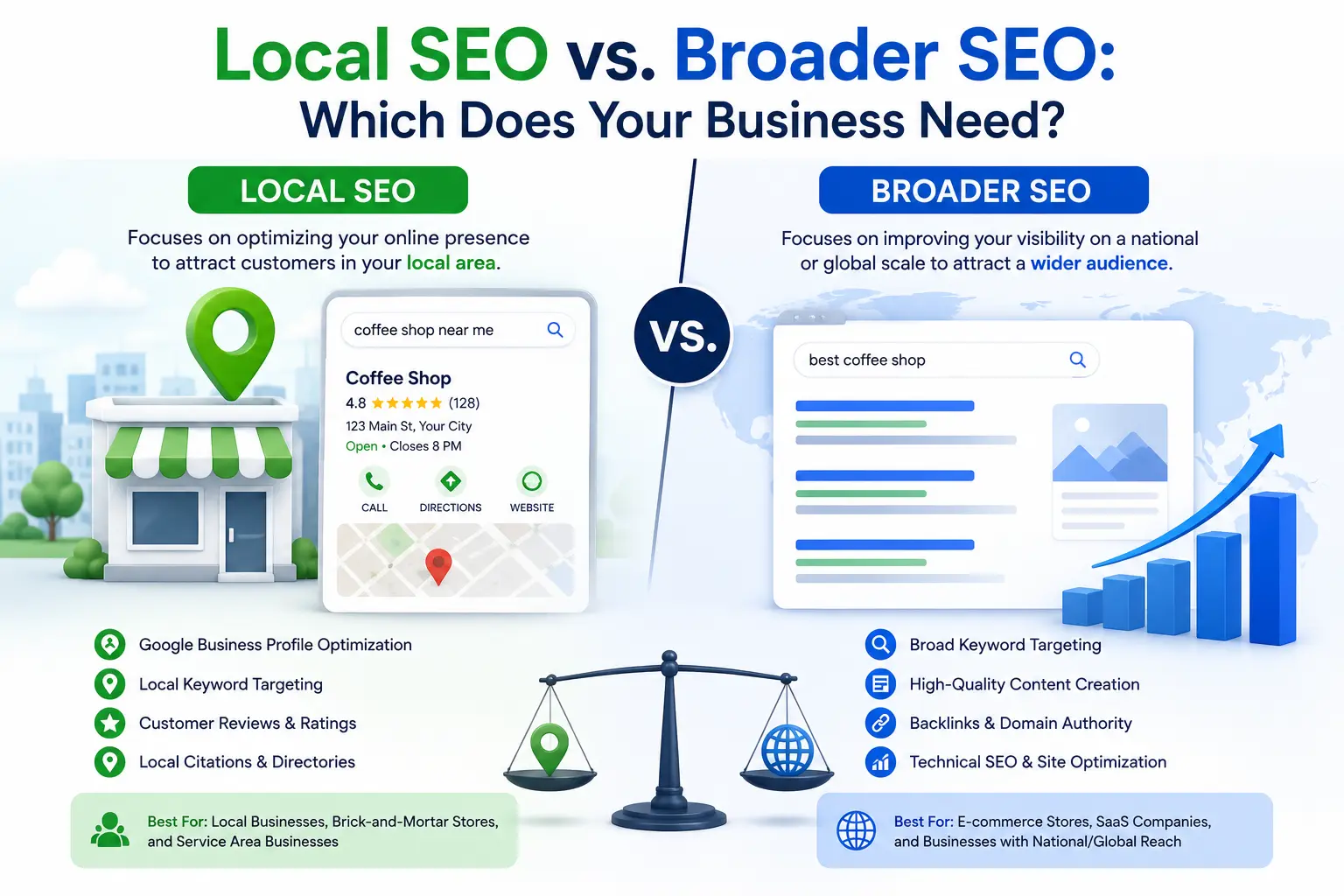
This distinction is worth dwelling on, because it directly affects which package makes sense for you.
Local SEO is the right focus if your customers are in a specific city, region, or service area — a restaurant, a dentist, a plumber, a boutique retailer. The priority is ranking in Google Maps and the local pack, building your Google Business Profile, and earning reviews and citations. The competition is your neighboring businesses, not national websites.
Broader/organic SEO becomes important when your customers aren’t geographically constrained — an e-commerce store, a SaaS product, a consultant who serves clients nationwide, a content-heavy site. Here, the focus shifts toward ranking nationally for competitive keywords, building topical authority through content, and earning links from relevant publications.
Many small businesses need both — local SEO for the “near me” searches and foundational organic SEO to compete on their core service keywords beyond just their immediate area.
A Practical Approach: How to Choose the Right Package
Here’s a simple framework for making the right choice:
- Know your goals. More phone calls? More e-commerce sales? More email sign-ups? The clearer you are about what success looks like, the easier it is to evaluate a provider.
- Research your local competition. Search your main keywords and see who ranks. Are the top results large national brands or other local businesses like yours? This tells you how much competition you’re facing.
- Set a realistic budget. Most small businesses should budget at least $500–$1,000/month for a package that includes meaningful content and link building. Anything less may not have enough resources to generate real results.
- Vet at least 3 providers. Request proposals, ask hard questions, and check references or case studies. Don’t sign with the first agency you speak to.
- Start with a shorter commitment. If possible, begin with a 3–6 month arrangement before committing to a year. This gives you time to evaluate performance without being locked in.
- Evaluate on the right metrics. The goal isn’t rankings for their own sake — it’s leads, calls, and revenue. Make sure your reporting connects SEO activity to business outcomes.
Frequently Asked Questions
What is included in a small business SEO package?
Most small business SEO packages include keyword research, on-page SEO, technical SEO, local SEO, content creation, link building, and monthly performance reporting. The exact services vary depending on the provider and pricing tier.
How much do small business SEO packages cost?
Small business SEO packages typically range from $300 to $5,000+ per month. Most businesses see the best balance of value and results in the $500–$1,500 monthly range.
How long does it take to see results from SEO?
SEO is a long-term strategy. Most businesses begin seeing early improvements within 3–4 months, while significant ranking and traffic gains usually occur after 6–12 months of consistent optimization.
Are SEO packages worth it for small businesses?
Yes. A well-managed SEO package can help small businesses attract qualified traffic, generate leads, and increase sales without relying entirely on paid advertising. The long-term benefits often outweigh the initial investment.
Does a small business SEO package include local SEO?
Many SEO packages include local SEO services such as Google Business Profile optimization, local citation management, review strategies, and local keyword targeting. These services are especially important for businesses serving a specific geographic area.
Can an SEO agency guarantee first-page rankings?
No. Reputable SEO agencies cannot guarantee specific rankings because search engine algorithms are constantly changing. Any provider promising guaranteed #1 rankings should be approached with caution.
What is the difference between local SEO and traditional SEO?
Local SEO focuses on improving visibility in location-based searches and Google Maps results. Traditional SEO targets broader organic search rankings and is often used by businesses serving regional, national, or global audiences.
How do I choose the best small business SEO package?
Look for a package that aligns with your goals, includes transparent deliverables, offers regular reporting, and focuses on long-term growth rather than quick promises. Comparing multiple providers before making a decision is also recommended.
Final Thoughts
A well-chosen small business SEO package is one of the most cost-effective ways to build a consistent, long-term source of customers. Unlike paid ads, the traffic you earn through SEO doesn’t disappear the moment you pause your budget — it compounds over time as your site builds authority and trust with Google.
But the keyword is “well-chosen.” The SEO industry has too many providers selling cheap promises and automated shortcuts that don’t work — and in some cases, actively hurt your website.
Do your homework, ask the right questions, and invest in a package that prioritizes real deliverables, transparent reporting, and a clear strategy tailored to your market. Give it 6–12 months of consistent effort. Done right, SEO is the marketing investment that keeps paying off long after the work is done.
You May Also Like It:
Website Performance Monitoring