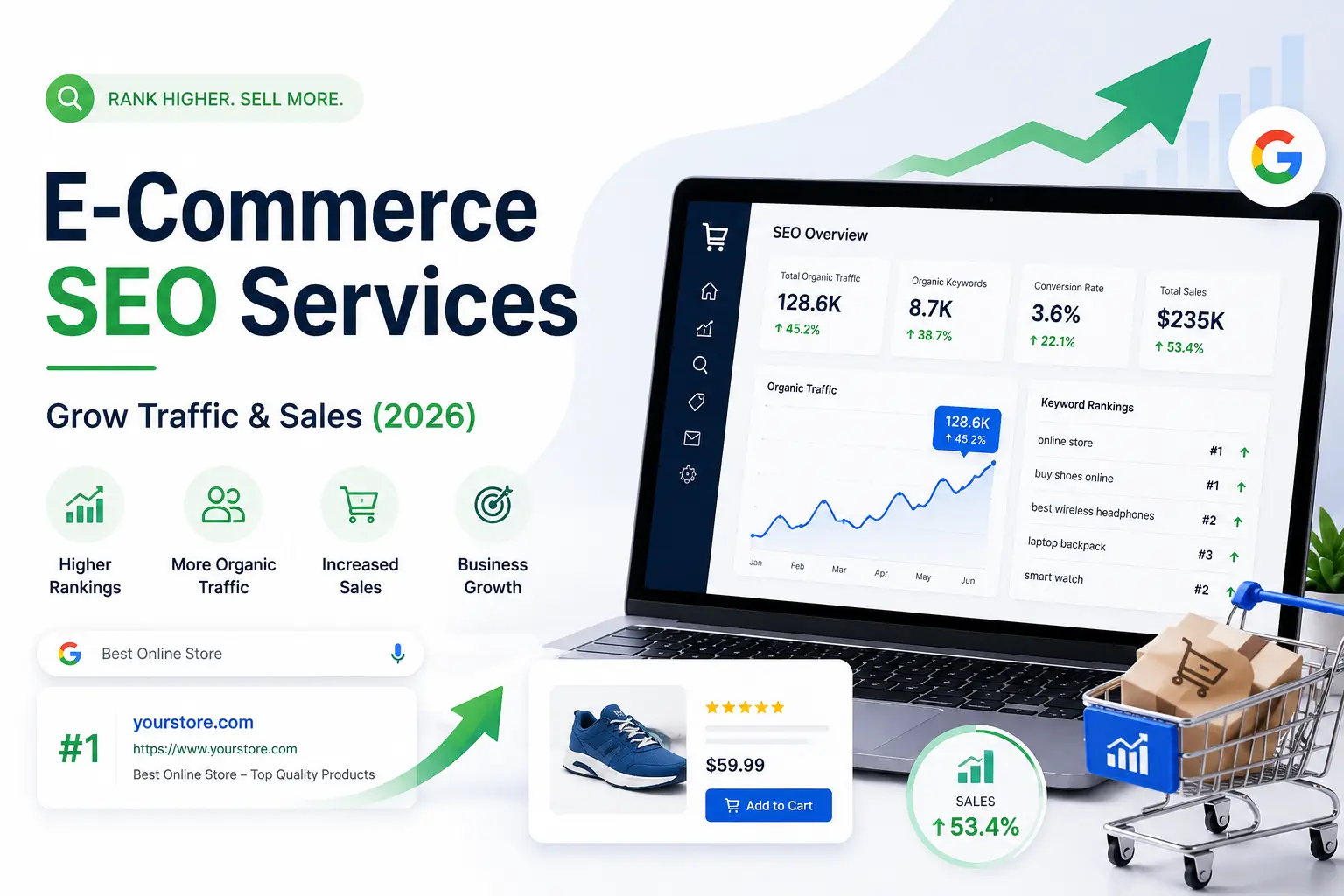
If you run an online store and you’re still relying entirely on paid ads to drive traffic, you’re essentially renting your customers — and the rent keeps going up.
E-Commerce SEO Services are the alternative. They help your store show up when buyers search for what you sell, without paying for every click. But “SEO” is one of those terms that gets thrown around constantly while meaning something slightly different to everyone who says it. This guide cuts through the noise.
Whether you’re evaluating an agency, trying to understand what you’d actually be paying for, or wondering if SEO is even worth it for your store — this is the clearest, most practical answer you’ll find.
What Are E-Commerce SEO Services?
E-Commerce SEO services are a set of ongoing strategies and technical work designed to improve an online store’s visibility in organic (unpaid) search results — primarily on Google, but increasingly also on AI-powered platforms like ChatGPT, Perplexity, and Google’s AI Overviews.
The goal isn’t just traffic. It’s qualified traffic: people who are actively searching for the products you sell, with buying intent.
What makes eCommerce SEO different from general SEO is scale and complexity. A standard website might have 20 to 50 pages. An eCommerce store can have thousands or even hundreds of thousands of product URLs, each needing unique descriptions, proper meta tags, structured data, internal links, and regular updates as inventory changes. Managing that at scale requires a completely different approach than what works for a blog or a service business website.
Why eCommerce SEO Matters More Than Ever in 2026
Paid advertising costs have risen significantly over the past few years. Competition on Google Shopping and Meta has intensified, and click-through rates on paid placements are becoming less predictable as AI-generated answers reshape the search results page.
Meanwhile, organic traffic compounds over time. A product category page that earns a top-three ranking keeps sending you buyers every month — without any additional spend per click. That’s the fundamental economic case for SEO.
Beyond cost-efficiency, there are three concrete reasons eCommerce SEO deserves serious investment right now:
Organic search still drives the majority of eCommerce traffic. Studies consistently show that organic search accounts for a larger share of online store traffic than any other channel. Buyers who find you through organic search often have higher intent and convert at stronger rates than those from social or display channels.
AI search is expanding, not replacing, organic opportunity. Google’s AI Overviews, ChatGPT’s shopping recommendations, and Perplexity’s product comparisons all pull from the web — and well-optimized eCommerce stores appear in these surfaces too. SEO in 2026 means optimizing for both traditional rankings and AI-generated responses.
SEO delivers compounding ROI. Unlike ads, which stop generating traffic the moment you pause the budget, organic rankings built through SEO keep working. The return on a well-executed SEO campaign typically improves over time as authority and rankings accumulate.
What E-Commerce SEO Services Actually Include
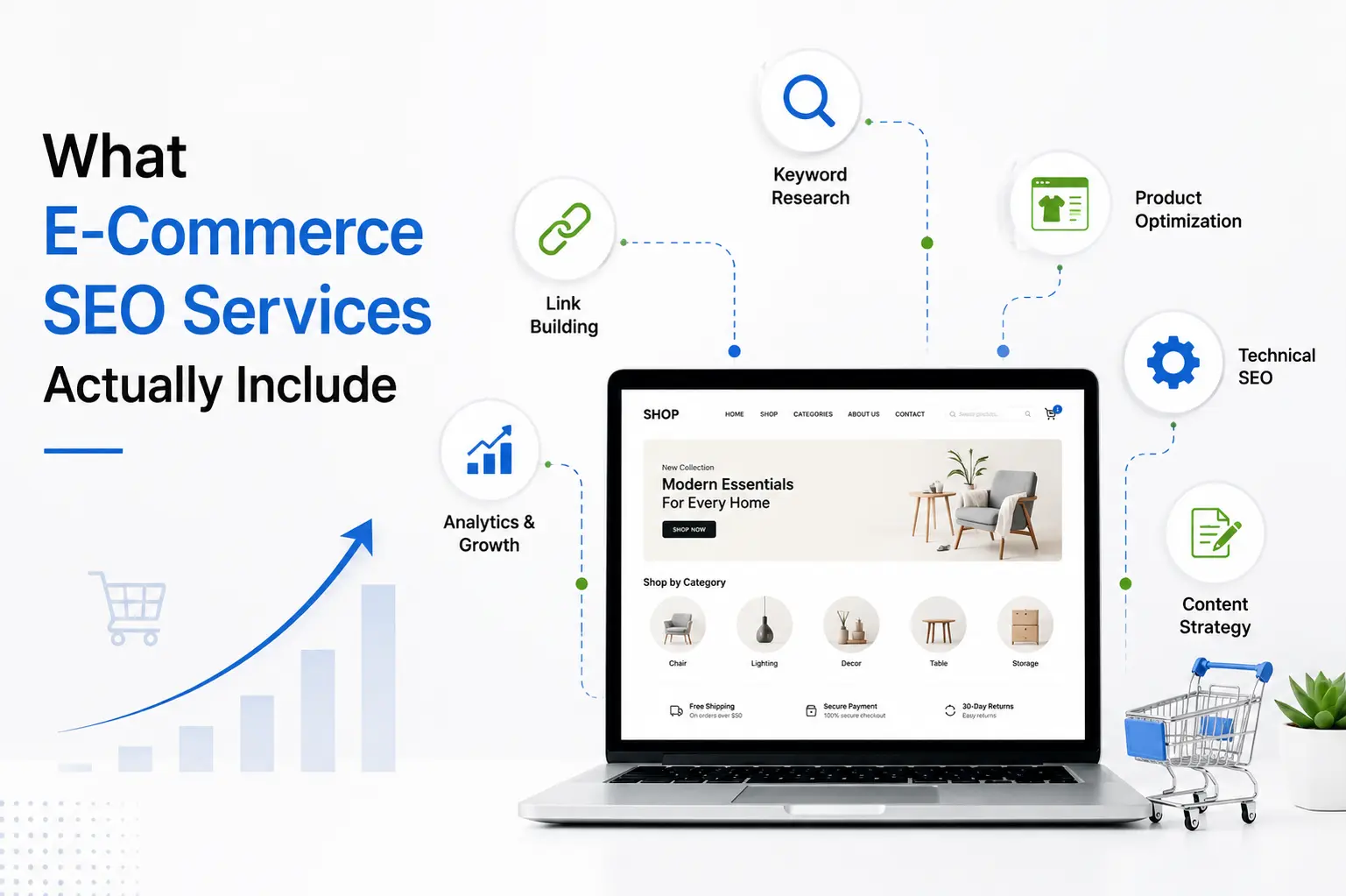
A complete eCommerce SEO engagement covers six core areas. Here’s what each one means in practice.
Step-by-Step E-Commerce SEO Process
1. Technical SEO Audit and Ongoing Maintenance
Technical SEO is the foundation. If search engines can’t crawl and index your pages efficiently, none of the other work matters.
For eCommerce stores, the most common technical issues include:
- Crawl budget waste: Large catalogs with thousands of pages can exhaust Googlebot’s crawl budget on low-value URLs (like filtered search result pages, empty category pages, or discontinued product URLs), leaving important pages under-crawled.
- Faceted navigation problems: Filter combinations (size, color, price range) often generate enormous numbers of near-duplicate URLs. Without proper canonical tags and crawl controls, these can cannibalize rankings and dilute authority.
- Core Web Vitals performance: Google uses page experience signals — loading speed, visual stability, interactivity — as ranking factors. For eCommerce stores with heavy product images and third-party scripts, meeting Core Web Vitals thresholds often requires dedicated engineering work. A Largest Contentful Paint (LCP) above 2.5 seconds is known to drop mobile conversion rates, not just rankings.
- Duplicate content from product variants: When the same product comes in five colors and each variant has its own URL with nearly identical content, Google sees thin, duplicate pages rather than a single authoritative product page.
- Schema markup: Structured data tells search engines what your pages contain — product name, price, availability, ratings — and enables rich results like star ratings and pricing directly in the search listings.
A strong technical SEO audit identifies these issues and prioritizes them by revenue impact, not just severity.
2. Keyword Research and Strategy
eCommerce keyword strategy operates differently than content marketing keyword research. The priority isn’t high-volume informational queries — it’s transactional and commercial queries that indicate purchase intent.
A good eCommerce keyword strategy segments targets into three types:
- Category-level keywords (“women’s running shoes,” “standing desk under $500”): high volume, competitive, typically the biggest revenue drivers when ranked well.
- Product-level keywords (“Nike Air Zoom Pegasus 41 size 8”): lower volume but extremely high intent — buyers searching specific model numbers are often seconds away from a purchase decision.
- Informational keywords (“how to choose a standing desk,” “best running shoes for flat feet”): used to build topic authority and capture shoppers early in their research phase, ultimately funneling them toward buying decisions.
The best eCommerce keyword strategies also map competitors’ ranking pages, identify gaps in your catalog’s coverage, and prioritize based on search volume, competition level, and your store’s existing authority.
3. On-Page Optimization: Product and Category Pages
This is where keyword strategy meets execution. On-page optimization for eCommerce covers:
Category pages: These are often the most important pages on an eCommerce site from an SEO perspective. They target high-volume buying queries and funnel traffic across entire product lines. Strong category pages include unique descriptive content at the top or bottom of the page, keyword-optimized headings, clear navigation filters, and internal links to subcategories and featured products.
Product pages: These target long-tail buying queries and convert at higher rates because visitors are further along in the decision process. Optimization includes title tags with product names and key attributes, unique product descriptions (not manufacturer copy-paste, which creates thin duplicate content), image alt text, structured data for price, availability, and reviews, and cross-links to related products.
Meta titles and descriptions: These appear directly in the search results. Well-written meta copy improves click-through rates, which is both directly valuable and a positive ranking signal.
URL structure: Clean, keyword-containing URLs (/running-shoes/womens/ rather than /category.php?id=47) are easier for both users and search engines to understand.
4. Content Development
Content does two things for eCommerce SEO: it builds topical authority that lifts your product and category page rankings, and it captures shoppers at earlier stages of their buying journey.
The highest-value content types for eCommerce include:
- Buying guides: “How to Choose the Right Running Shoe” captures someone early in their research. Internal links from that guide to your category and product pages pass relevance signals and guide the shopper toward a purchase.
- Comparison articles: “X vs. Y” content captures buyers who’ve narrowed their options but haven’t made a final decision. These pages often rank for very high-converting queries.
- How-to and use-case content: Demonstrates product value, answers pre-purchase questions, and builds trust — all while generating organic traffic.
- Product-specific FAQs: Address the questions buyers actually ask before purchasing. These often surface directly in Google’s “People Also Ask” boxes.
One pattern many competitors miss: the content that drives the most revenue isn’t always blog content — it’s often the descriptive text on category pages that’s been rewritten to answer buyer questions while embedding the right keywords naturally.
5. Link Building and Authority Development
Domain authority — the trust and credibility signals Google associates with your website — is one of the most important factors in how well your pages rank. For eCommerce stores, authority comes primarily from other reputable websites linking to yours.
Effective link building for eCommerce focuses on:
- Editorial placements: Getting your products, expertise, or data mentioned in industry publications, gift guides, and roundup articles.
- Digital PR: Creating linkable assets — original data, research, useful tools — that earn organic coverage.
- Supplier and partner links: Manufacturers and distributors often link to authorized retailers; these are often untapped opportunities.
- Resource page links: Directories and resource lists in your niche are straightforward placements when your content genuinely belongs there.
Low-quality link building — mass-produced guest posts, directory submissions, link farms — can actively harm rankings. Algorithm updates specifically target manipulative link patterns.
6. Product Feed and AI Shopping Optimization
This is an area many agencies haven’t caught up on yet, and it’s becoming increasingly important.
Modern eCommerce SEO extends beyond the website itself to include:
- Google Merchant Center and product feed optimization: Product title structure, attribute completeness, GTIN accuracy, and category mapping all affect whether your products appear in Google Shopping results. Feed errors and policy disapprovals can silently suppress visibility.
- AI Shopping panel optimization: Google’s AI-generated shopping summaries and comparison results pull structured product data. Stores whose product information is complete, accurate, and consistently formatted are more likely to appear in these placements.
- Multi-platform visibility: Ensuring your store’s information is consistent across Google Search, Google Shopping, ChatGPT shopping recommendations, and Perplexity results requires deliberate optimization work that goes beyond traditional SEO.
7. Reporting and Revenue Tracking
Any serious eCommerce SEO engagement should be measured against revenue, not just rankings or traffic. The reporting framework should track:
- Organic traffic by landing page category (product pages vs. category pages vs. blog content)
- Revenue generated from organic search (via Google Analytics 4 eCommerce tracking)
- Keyword ranking movements for priority terms
- Conversion rate from organic visitors
- Core Web Vitals scores and technical health metrics
The distinction between traffic growth and revenue growth matters. Ranking informational content can generate significant traffic without proportional revenue impact. The most valuable ranking improvements typically come from product and category pages targeting high-intent commercial queries.
eCommerce SEO vs. Paid Advertising: Understanding the Difference
Both channels have legitimate roles, but they work differently and serve different business needs.
| Factor | eCommerce SEO | Paid Search / Shopping Ads |
|---|---|---|
| Cost per click | No direct cost per click | Paid per click |
| Time to results | 3–12 months | Immediate |
| Long-term value | Compounds over time | Stops when budget stops |
| Targeting | Keyword intent-based | Keyword + audience-based |
| Best for | Sustainable long-term growth | Testing, seasonal spikes, new products |
The most effective eCommerce marketing strategies use both. Paid ads provide immediate visibility and allow rapid testing of product messaging. SEO builds the organic foundation that reduces dependency on paid channels over time. A common mistake is treating them as either/or choices rather than complementary channels.
How Much Do E-Commerce SEO Services Cost?
Pricing varies significantly based on your store’s size, competitive landscape, and the depth of service required. Here’s an honest breakdown based on current industry data:
Small eCommerce stores (up to ~200 products): $500–$1,500 per month. Covers foundational technical setup, basic on-page optimization for core pages, and keyword research.
Mid-sized stores (200–5,000 products): $1,500–$5,000 per month. Adds content development, more comprehensive link building, and deeper technical management.
Large or enterprise stores (5,000+ products): $5,000–$15,000+ per month. Requires dedicated technical SEO management, large-scale content operations, and aggressive authority building to compete for high-value terms.
One-time project work (audits, site migrations, specific optimization sprints) typically runs $2,000–$10,000 depending on scope.
A note on ROI: SEO is a long-term investment. Ranking improvements often begin appearing within 3–4 months, but meaningful conversion lift — particularly for competitive keywords — typically takes 6–12 months. An eCommerce store investing $4,000/month in SEO that reaches $22,000/month in incremental organic revenue after 12 months represents a 450% ROI. These aren’t guaranteed numbers, but they reflect what well-executed campaigns achieve for established stores in competitive categories.
Red Flags When Evaluating E-Commerce SEO Services
Not all agencies deliver what they promise. Watch for these warning signs:
Guaranteed rankings: No one can guarantee specific search rankings. Google’s algorithm involves hundreds of signals, and any agency claiming otherwise is either misleading you or planning to use risky tactics that may cause short-term gains but long-term penalties.
Vague deliverables: “We’ll optimize your site” means nothing without specifics. A good agency can tell you exactly which pages will be worked on, what changes will be made, and why those changes are expected to produce results.
Quantity-focused link building: Promises of “50 backlinks per month” should raise immediate concern. Link quality and relevance matter far more than volume. A single editorial link from a respected industry publication outweighs hundreds of low-quality directory submissions.
Reporting only on rankings: Rankings are an input, not an outcome. If your agency’s monthly report shows keyword positions but doesn’t connect them to organic revenue, you’re missing the metric that actually matters.
No discussion of your specific technical issues: Any credible eCommerce SEO audit will surface technical problems specific to your store. If an agency skips this step and jumps straight to content plans, they haven’t done the foundational work.
What to Look For in an eCommerce SEO Agency
When evaluating providers, ask these questions:
Do they have experience with your specific platform? SEO implementation on Shopify differs meaningfully from WooCommerce, Magento, or BigCommerce. Platform-specific expertise matters because the technical constraints and optimization opportunities are different.
How do they handle product feed optimization? Agencies that only work on your website and ignore your Google Merchant Center feed are leaving significant visibility on the table.
Can they show examples of revenue impact? Case studies should include organic traffic growth, ranking improvements and the revenue impact. Avoid agencies that can only show traffic metrics.
What does their reporting look like? Ask to see a sample report. It should include keyword rankings, organic traffic, revenue attribution, and the work completed that month — not just a summary slide.
How do they approach AI search optimization? Given how quickly Google’s AI Overviews and third-party AI tools have integrated shopping results, an agency that can’t speak to this is behind the curve.
Should You Do eCommerce SEO In-House or Hire an Agency?
This depends on your resources and your goals.
In-house SEO makes sense when: You have a dedicated SEO specialist or team with eCommerce experience, your catalog is stable and manageable in size, and you have sufficient content and development resources to execute at the required pace.
Agency SEO makes sense when: You don’t have specialized SEO expertise on staff, your catalog is large and technically complex, you want faster results than an in-house build-up would provide, or you need the breadth of skills (technical, content, link building) that a single hire can’t cover.
A hybrid model works well for many mid-sized brands: an agency handles technical strategy, link building, and content creation, while an in-house team manages day-to-day product page updates and executes on the agency’s recommendations.
Getting Started: What to Expect in the First 90 Days
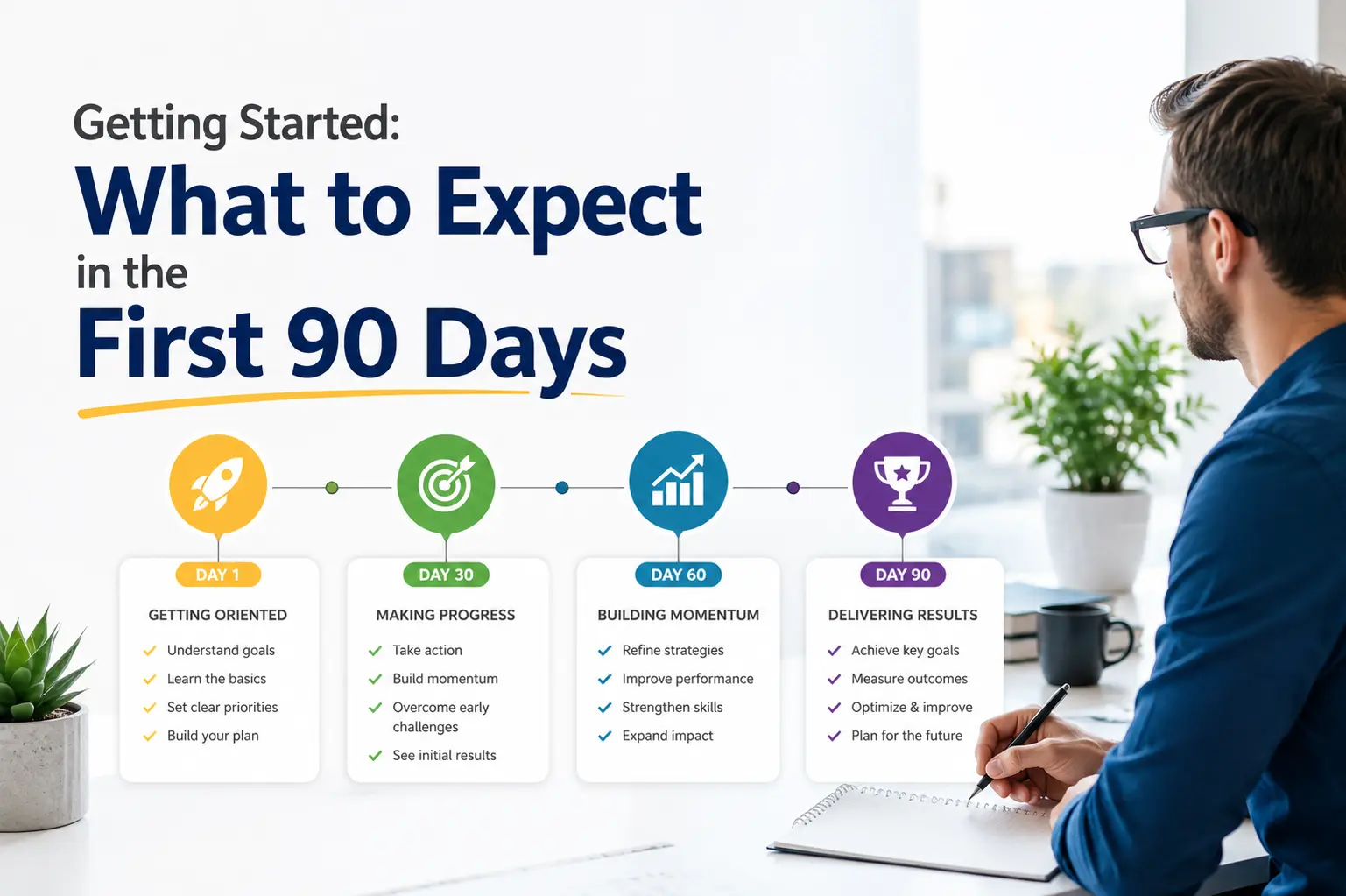
A realistic timeline for a new eCommerce SEO engagement looks like this:
Month 1: Technical audit, keyword research, competitor analysis, and prioritization. Initial quick wins — fixing critical technical errors, optimizing existing high-traffic pages — are often implemented here.
Month 2: On-page optimization rollout for priority category and product pages. Content strategy development. Link building outreach begins.
Month 3: First ranking movement for target keywords. Content publication begins. Reporting framework established with baseline organic revenue metrics.
Months 4–6: Compounding impact begins as search engines recognize the improved signals. Product and category pages targeting high-intent terms start moving into top-10 positions.
Months 6–12: Significant organic revenue lift for stores in competitive categories. Content authority builds across the site. Ranking volatility decreases as domain authority grows.
The most important expectation to set: SEO is a marathon, not a sprint. Stores that treat it as a long-term growth channel — and invest consistently — are the ones that build a durable advantage. Stores that start, stop, and restart based on short-term impatience rarely see the compounding returns that make SEO so powerful.
FAQs
What are E-Commerce SEO Services?
E-Commerce SEO Services are strategies and optimization techniques designed to improve an online store’s visibility in search engines. These services help product pages, category pages, and other website content rank higher, driving more organic traffic and sales.
How long does it take to see results from E-Commerce SEO Services?
Most online stores begin seeing initial improvements within 3 to 6 months. However, competitive industries may require 6 to 12 months of consistent SEO work to achieve significant rankings and revenue growth.
How much do E-Commerce SEO Services cost?
The cost depends on the size of your store and the level of competition. Small stores may spend a few hundred dollars per month, while larger eCommerce businesses often invest several thousand dollars monthly for comprehensive SEO campaigns.
Are E-Commerce SEO Services better than paid advertising?
SEO and paid advertising serve different purposes. Paid ads generate immediate traffic, while SEO builds long-term organic visibility. Many successful online stores use both strategies together to maximize growth and profitability.
Can Shopify and WooCommerce stores benefit from SEO?
Yes. Platforms like Shopify, WooCommerce, Magento, and BigCommerce can all benefit from E-Commerce SEO Services. Proper optimization helps these stores attract more qualified visitors and improve conversion rates.
What should I look for in an E-Commerce SEO agency?
Look for an agency with proven eCommerce experience, transparent reporting, technical SEO expertise, content optimization skills, and a focus on revenue growth rather than just keyword rankings.
Final Thought
The best time to start investing in E-Commerce SEO was when you launched your store. The second best time is now.
Every month without a strong organic presence is another month your competitors are building the ranking advantage that makes them harder to catch. And every month you invest in SEO is another month of compound interest being added to your organic visibility.
Done right, E-Commerce SEO services aren’t a cost — they’re the highest-ROI growth investment your store can make.
You May Also Like It:
Website Development for Startups
Qantas 787 Business Class Review