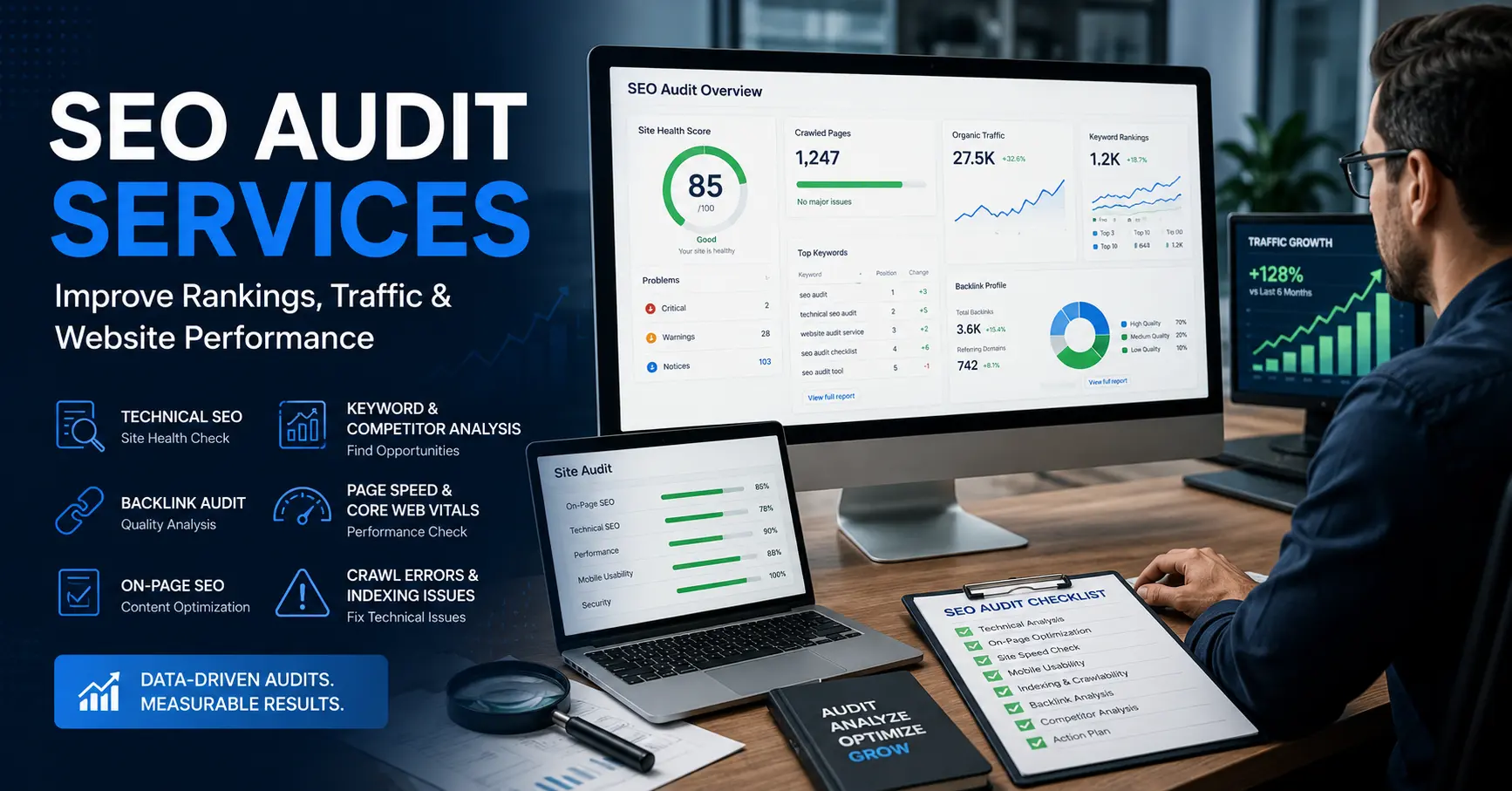
If your website isn’t ranking where you expect it to, an SEO audit is usually the first—and most important—place to start. Before you invest thousands in content creation or link building, you need to know why you’re not ranking. An SEO audit answers that question.
This guide covers everything you need to know about professional SEO Audit Services: what they actually examine, what you’ll receive, what they cost, and how to pick a provider that will give you real, actionable insights—not a generic checklist.
What Is an SEO Audit Service?
An SEO audit service is a structured analysis of your website performed by an SEO professional or agency. The goal is to identify every technical, content, and authority-related issue that prevents your site from ranking higher on Google and other search engines.
Unlike a quick free tool scan, a professional SEO audit goes layer by layer through your site’s architecture, content quality, link profile, user experience, and competitive positioning. The result is a prioritized list of issues—and a clear plan to fix them.
Think of it like a physical check-up for your website. You wouldn’t treat a symptom without diagnosing the cause. An SEO audit is the diagnosis.
Why SEO Audits Matter More Than Ever
Google updates its algorithm thousands of times a year. Core updates in 2022–2024 (Helpful Content, Spam, and several core updates) dramatically changed what it takes to rank. Sites that were performing well two years ago may now be underperforming—not because of anything they did wrong, but because the rules shifted.
An audit catches these gaps before they become expensive problems:
- Crawling and indexing issues can make pages invisible to Google entirely
- Thin or duplicate content can trigger ranking penalties or suppression
- Slow page speed increases bounce rate and suppresses rankings
- Broken backlinks erode domain authority over time
- Missing E-E-A-T signals (Experience, Expertise, Authoritativeness, Trust) can reduce a page’s ability to rank well, even against less detailed or lower-quality content.
What a Professional SEO Audit Covers
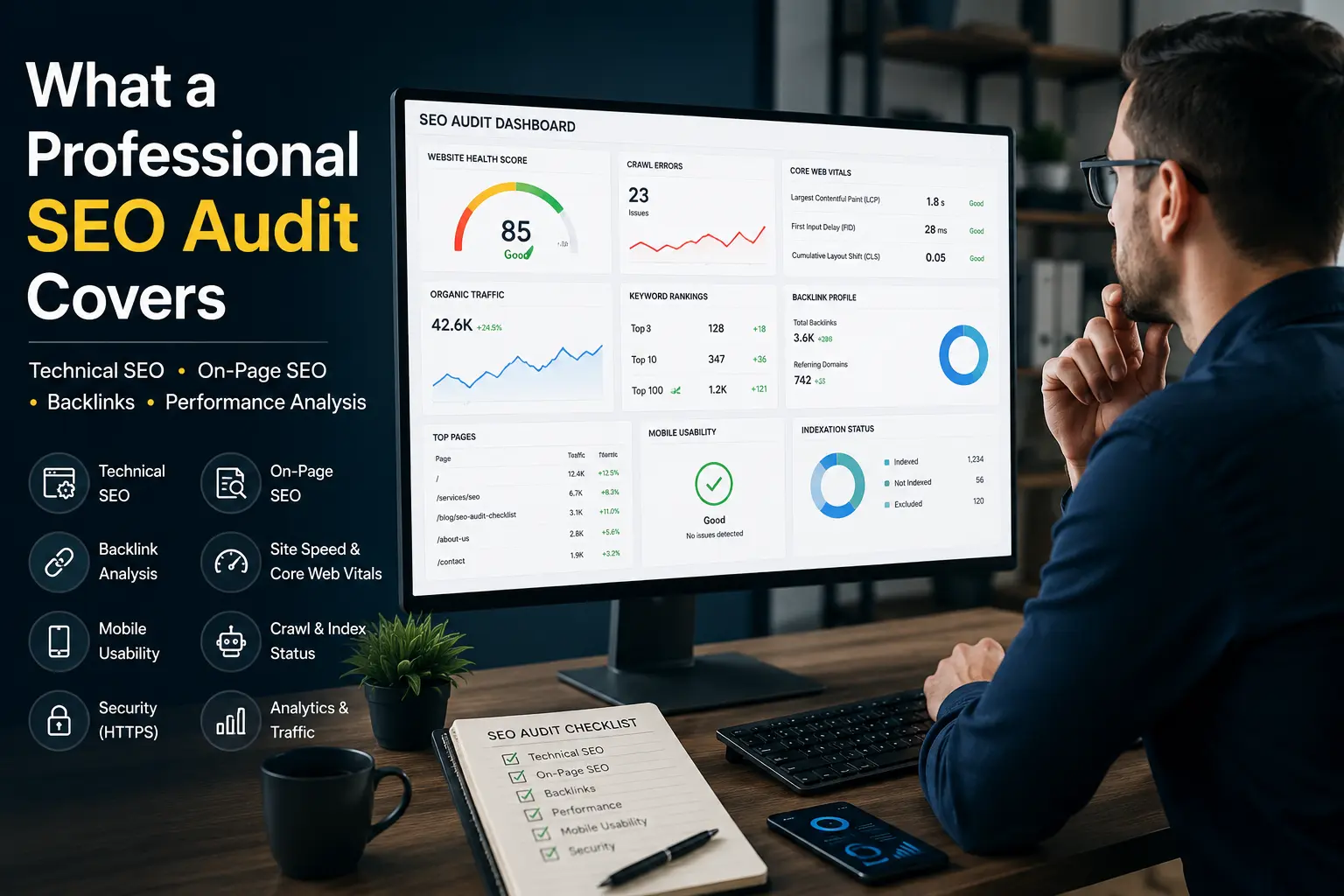
A thorough SEO audit isn’t a single check—it’s a multi-layered examination. Here’s what reputable providers evaluate:
1. Technical SEO Analysis
This is the foundation. If Google can’t crawl or index your pages correctly, nothing else matters.
- Crawlability: Are there orphaned pages, blocked directories, or noindex tags applied incorrectly?
- Indexation: Which pages are indexed? Which are excluded—and should they be?
- XML sitemap: Is it up to date, submitted to Google Search Console, and error-free?
- Robots.txt: Does it accidentally block important pages?
- Site architecture: Is the internal linking structure logical and flat enough for crawlers to reach every page efficiently?
- Canonicalization: Are canonical tags preventing duplicate content issues?
- HTTPS and security: Is the site fully migrated to HTTPS? Are there mixed content warnings?
- Mobile-friendliness: Does the site pass Google’s mobile usability standards?
- Core Web Vitals: LCP (Largest Contentful Paint), FID/INP (Interaction to Next Paint), and CLS (Cumulative Layout Shift)—all measured and benchmarked
- Structured data / Schema markup: Is rich result eligibility being maximized?
- Redirect chains and 404 errors: Are broken links and redirect loops dragging down crawl efficiency?
- International SEO: For multi-language or multi-region sites, are hreflang tags implemented correctly?
2. On-Page SEO Audit
Technical issues may be invisible to users, but on-page problems affect both rankings and reader trust.
- Title tags and meta descriptions: Are they optimized, within character limits, and unique per page?
- Header structure (H1–H6): Is there a single, keyword-relevant H1? Are subheadings used logically?
- Keyword targeting: Does each page target a clearly defined primary keyword with relevant secondary terms?
- Content depth and quality: Does the content fully address search intent? Is it more comprehensive or more helpful than competing pages?
- Duplicate content: Are there near-identical pages competing against each other?
- Content cannibalization: Are multiple pages targeting the same keyword, splitting authority?
- Image optimization: Alt text, file names, compression, and next-gen formats (WebP)
- Internal linking: Are high-value pages supported with contextual links from related content?
- URL structure: Are URLs short, descriptive, and keyword-relevant?
3. Off-Page / Backlink Audit
Your backlink profile remains one of Google’s strongest ranking signals. A backlink audit should evaluate both authority and potential risks.
- Total backlink count and referring domains
- Link quality assessment: Are links coming from relevant, authoritative websites?
- Toxic link identification: Detect potentially harmful or spammy backlinks
- Anchor text distribution: Ensure a natural and diverse anchor profile
- Link velocity analysis: Review unusual spikes or drops in backlink acquisition
- Link opportunity analysis: Identify authoritative websites linking to similar content in your industry
- Disavow file review: Confirm it is current and properly configured
4. Content Audit
Content audits are often among the highest-ROI parts of an SEO audit.
- Content inventory: Categorize pages by traffic, engagement, and conversions
- Underperforming content: Find pages ranking on page 2–3 with page 1 potential
- Outdated content: Identify articles requiring updates or refreshed data
- E-E-A-T assessment: Review expertise, experience, authority, and trust signals
- Search intent alignment: Ensure content matches user expectations
- Content gap analysis: Discover valuable topics and keyword opportunities not currently covered
5. Competitive Analysis
A comprehensive audit should benchmark your website against top-ranking sites in your niche.
- Identify the strongest sites competing for your target keywords
- Keyword gap analysis: Find valuable keywords driving traffic elsewhere in your market
- Content comparison: Evaluate topic depth, structure, and usefulness
- Authority comparison: Assess relative backlink strength and ranking potential
- SERP feature analysis: Identify opportunities for featured snippets, FAQs, and other search features
6. Local SEO Audit (If Applicable)
For businesses with physical locations or service areas:
- Google Business Profile optimization review
- NAP consistency audit
- Local citation analysis
- Local landing page optimization review
- Review profile assessment and reputation analysis
What You Should Receive at the End of an Audit
This is where providers vary enormously. A professional audit deliverable should include:
- An executive summary: The 5–10 highest-priority issues explained in plain language, with the business impact of each
- Full technical report: Every issue found, with severity ratings (critical / high / medium / low), what it means, and how to fix it
- Content and keyword recommendations: Specific pages to improve, consolidate, or create, with target keywords
- Backlink report: Quality assessment of your current profile plus a link gap analysis
- Prioritized action plan: Issues ranked by impact and implementation difficulty, so your team knows exactly where to start
- Competitor benchmarks: Side-by-side comparisons for authority, content coverage, and keyword rankings
- Baseline metrics: DA/DR, total indexed pages, organic traffic estimates—so future progress can be measured against a starting point
Red flag: If a provider gives you a PDF of automated tool screenshots without interpretation, actionable recommendations, or prioritization, that’s not a real audit—it’s a report dressed up as one.
How Long Does an SEO Audit Take?
Timeline depends on site size and audit depth:
| Site Size | Estimated Time |
|---|---|
| Small (under 100 pages) | 1–2 weeks |
| Medium (100–1,000 pages) | 2–4 weeks |
| Large (1,000–10,000 pages) | 4–6 weeks |
| Enterprise (10,000+ pages) | 6–12 weeks |
Beware of providers who promise a “complete” audit on a large site in 24–48 hours. Automated tools can generate reports quickly, but interpreting findings, cross-referencing issues, and writing actionable recommendations takes expert time.
How Much Do SEO Audit Services Cost?
Pricing varies widely based on site complexity, audit depth, and provider reputation:
| Audit Type | Price Range |
|---|---|
| Automated / Tool-Generated Audit | Free – $500 |
| Basic Professional Audit (Small Site) | $500 – $2,500 |
| Comprehensive Audit (Mid-Size Site) | $2,500 – $7,500 |
| In-Depth Audit + Strategy (Large Site) | $7,500 – $20,000+ |
| Enterprise-Level / Ongoing Audit Program | $20,000 – $50,000+ |
The cheapest options are rarely worth it. An audit at $200 is almost certainly automated output—no senior SEO strategist is spending 20+ hours on a five-figure analysis for $200.
That said, paying more doesn’t automatically guarantee quality. Look for providers who:
- Can walk you through their audit methodology before you sign
- Provide sample deliverables or case studies
- Have verified client results, not just testimonials
- Are willing to explain findings in a debrief call
The “Fix Prioritization” Problem
Most SEO audits list hundreds of issues. Most businesses fix the easy ones first—low-effort items like adding alt text or fixing a missing meta description. Those matter, but they’re rarely the reason a site is underperforming.
The highest-value audits help you focus on the 20% of issues driving 80% of the ranking suppression. This is rarely what automated reports surface first, because automated tools can’t tell the difference between:
- A duplicate title tag on a page that gets 2 visits a month (low impact)
- A crawl budget problem preventing 400 key product pages from being indexed (high impact)
A great audit provider ranks issues by business impact, not just technical severity. Ask any prospective provider: “How do you prioritize findings?” If the answer is vague, that’s telling.
Another Gap: Audit Without Implementation Support
An audit document sitting in a shared Google Drive does nothing for rankings. Yet many agencies deliver the audit and walk away.
Look for providers who offer:
- A debrief call to walk through findings and answer questions
- Post-audit implementation support—either doing the work themselves or guiding your in-house team
- A follow-up check-in (typically 90 days post-audit) to measure impact and identify new priorities
- Progress tracking dashboards so you can see keyword movement, traffic changes, and technical improvements over time
The audit is the diagnosis. Implementation is the treatment. You need both.
How to Choose the Right SEO Audit Provider
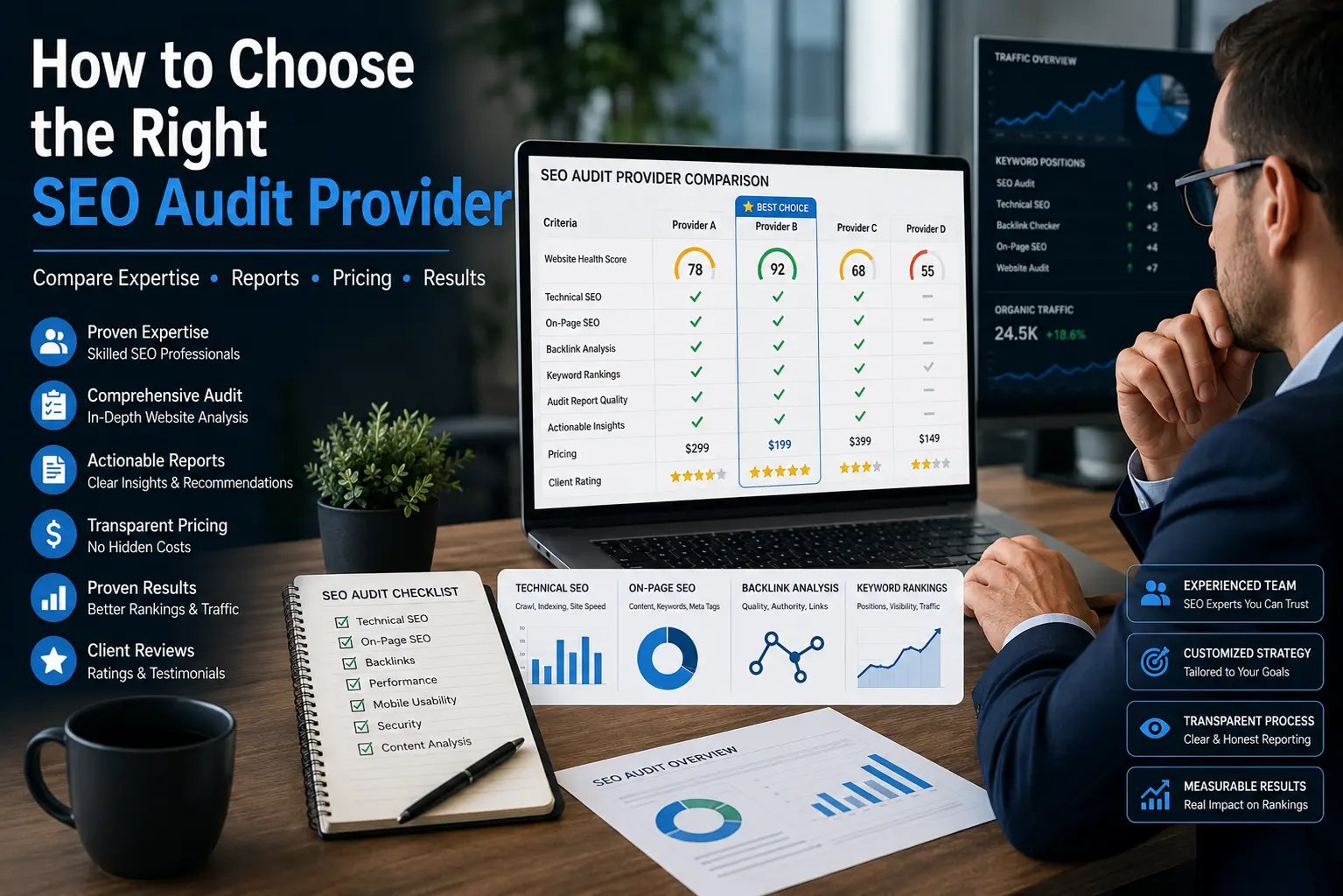
Use this checklist when evaluating agencies or consultants:
Before signing:
- Ask for a sample deliverable or anonymized case study
- Confirm what tools they use (Screaming Frog, Ahrefs, SEMrush, Google Search Console, Lighthouse, etc.)
- Ask who performs the audit—senior SEO or a junior using a template?
- Clarify what’s included: technical only, or content + backlinks + competitive analysis?
- Ask how they prioritize findings
- Confirm whether a debrief call is included
Green flags:
- Transparent methodology and process documentation
- Published case studies with before/after metrics
- Clear, human-readable deliverables—not just exported tool reports
- Willingness to answer detailed methodology questions
- References you can contact
Red flags:
- “SEO audit in 24 hours” promises
- Heavily templated reports with minimal customization
- No debrief or follow-up included
- Pushy upsell into a retainer before the audit is complete
- Refusing to explain their process before you pay
DIY vs. Professional SEO Audit: When Each Makes Sense
A professional SEO audit is not always necessary. Here’s a realistic breakdown:
DIY makes sense when:
- Your site is under 50 pages and relatively simple
- You have in-house SEO experience
- Budget is a major constraint
- You’re doing a quick health check before a site migration
Professional audit is worth it when:
- Your organic traffic has dropped significantly and you don’t know why
- You’re launching a major content initiative and need a clean foundation
- You’ve done on-page work but aren’t ranking
- You’re in a competitive niche where technical precision matters
- Your site has thousands of pages and crawl efficiency is a concern
- You’ve recently migrated your site or CMS
Free tools like Google Search Console, Screaming Frog’s free tier, and Ahrefs Webmaster Tools can surface many issues. But interpreting what they mean, understanding their relative importance, and building a strategy around findings requires experience.
Key SEO Audit Tools Professionals Use
Understanding the tools used in a professional audit helps you evaluate whether a provider is doing thorough work:
| Tool | Primary Use |
|---|---|
| Screaming Frog SEO Spider | Technical crawl (status codes, redirects, on-page elements) |
| Ahrefs / SEMrush | Backlink analysis, keyword gap, rank tracking |
| Google Search Console | Indexation, Core Web Vitals, search performance |
| Google Analytics / GA4 | Traffic patterns, user behavior, conversion data |
| PageSpeed Insights / Lighthouse | Performance and Core Web Vitals testing |
| Sitebulb | Visual crawl analysis and architecture mapping |
| Lumar (formerly Deepcrawl) | Enterprise-scale technical crawling |
| Majestic | Backlink trust flow and citation flow metrics |
| Surfer SEO / Clearscope | Content optimization and keyword depth analysis |
A provider using only one or two of these is likely producing a shallow audit.
Questions to Ask After Receiving Your Audit
Once you have your audit deliverable, push your provider on these points:
- What are the three issues most responsible for our current ranking decline? (If they can’t answer confidently, that’s a problem.)
- If we fix only five things in the next 30 days, what should they be?
- Which of these issues can our in-house team handle vs. which require specialist support?
- How do our Core Web Vitals compare to top-ranking pages in our niche?
- Is there anything in our backlink profile that poses a genuine penalty risk?
The best providers have immediate, specific, confident answers to all of these.
Frequently Asked Questions
Can an SEO audit guarantee rankings improvements?
No reputable provider will guarantee specific rankings—and you should be skeptical of any that do. What an audit does guarantee is a clear picture of what’s holding you back. Acting on that picture is what produces ranking improvements.
What’s the difference between a technical SEO audit and a full SEO audit?
A technical audit covers crawlability, indexation, performance, and site structure. A full audit adds content quality, backlink profile, competitive gap analysis, and keyword strategy. Most businesses need a full audit, though technical-only audits are useful after site migrations or CMS changes.
Do I need an audit if my traffic is growing?
Possibly. Even if your site is growing, an SEO audit can uncover hidden issues, missed opportunities, and ranking risks that may be limiting future growth.
What if I’ve already had an audit done by a previous agency?
Get a second opinion. Audit quality varies enormously. If the previous audit didn’t produce measurable improvements within 6 months of implementation, there’s a good chance it missed something important—or implementation was incomplete.
Summary: What to Look for in an SEO Audit Service
| Factor | What to Look For |
|---|---|
| Scope | Technical SEO, content analysis, backlink audit, and competitive analysis |
| Deliverable | A prioritized action plan, not just a list of errors |
| Methodology | Named SEO tools, a multi-layer audit process, and senior SEO involvement |
| Support | Debrief call, implementation guidance, and follow-up check-ins |
| Proof | Case studies, verifiable results, and client references |
| Timeline | Realistic timelines based on site size—not suspiciously fast promises |
| Price | Reflects genuine expert analysis and time investment—not a cheap automated report |
An SEO audit is an investment. Done right, it’s the most efficient way to find and fix the specific issues preventing your site from reaching its full organic potential. Done poorly, it’s a PDF that collects digital dust.
You May Also Like It:
Website Development for Startups
Qantas 787 Business Class Review