Every day, potential customers search Google for solutions, products, and services. If your website does not appear in those search results, they will likely find one of your competitors instead.
The challenge is not simply publishing more content. It is publishing content that answers the right questions, demonstrates expertise, and encourages visitors to take action.
That is where professional SEO content writing services make a measurable difference.
A well-planned SEO content strategy helps your business attract qualified visitors, build trust with your audience, and generate consistent organic traffic over time. Instead of relying solely on paid advertising, your content becomes a long-term asset that continues to bring in potential customers long after it is published.
Whether you run a local business, an ecommerce store, a SaaS company, or a B2B brand, investing in high-quality SEO content can improve your visibility, strengthen your authority, and support sustainable business growth.
In this guide, you will learn what SEO content writing services include, how they influence search rankings, what separates exceptional content from average content, and how to choose an approach that delivers lasting results.
What Are SEO Content Writing Services?

SEO content writing services involve researching, planning, writing, optimizing, and updating content that is designed to perform well in search engines while providing genuine value to readers.
Contrary to a common misconception, SEO content writing is not about inserting keywords into every paragraph. Modern search engines evaluate content based on how well it satisfies user intent, demonstrates expertise, and answers questions clearly.
Professional SEO content writing combines several essential elements into a single strategy:
- Comprehensive keyword and topic research
- Search intent analysis
- User-focused writing
- Logical content structure
- On-page SEO optimization
- Internal linking
- Conversion-focused messaging
- Regular content updates
The objective is not simply to achieve higher rankings. The real goal is to attract the right audience, keep them engaged, and encourage meaningful actions such as submitting an inquiry, booking a consultation, or completing a purchase.
Why SEO Content Writing Matters More Than Ever
Publishing content without a clear strategy often leads to disappointing results. Many websites produce dozens of articles every month but see little improvement in rankings or traffic because the content fails to address what users actually need.
Professional SEO content writing focuses on creating content that serves both search engines and real people.
When executed correctly, it can help you:
- Increase organic traffic from relevant searches
- Build credibility and authority within your industry
- Improve user engagement and reduce bounce rates
- Generate qualified leads through informative content
- Support other marketing channels such as email campaigns and social media
- Strengthen your website’s topical authority over time
Unlike paid advertising, quality content continues to deliver value long after publication. A well-optimized article can generate traffic, leads, and brand awareness for months or even years with regular updates.
Why Many SEO Content Strategies Fail
One of the biggest misconceptions is that publishing content regularly guarantees better rankings.
In reality, consistency without strategy often creates a library of pages that compete with each other instead of building authority.
Some of the most common mistakes include:
Writing for Keywords Instead of People
Content created solely around keywords often feels repetitive and provides little practical value. Google’s algorithms increasingly reward pages that answer questions thoroughly and naturally.
Ignoring Search Intent
Someone searching for “SEO content writing services” is usually comparing providers or looking for professional help, not reading a basic definition of SEO. Content that does not match this intent struggles to rank.
Publishing and Forgetting
Search results change over time. Competitors update their content, user expectations evolve, and Google’s algorithms continue to improve. Without regular updates, even high-performing pages can lose visibility.
Focusing on Rankings Instead of Business Goals
High rankings are valuable only if they bring the right audience. Effective SEO content should support measurable business objectives such as lead generation, customer acquisition, and brand authority.
Expert Insight
One pattern consistently seen across successful websites is that they treat content as an ongoing business asset rather than a one-time marketing task.
Instead of asking, “How many keywords should we include?”
They ask:
- Does this page fully answer the visitor’s question?
- Is it more useful than competing pages?
- Would someone bookmark or share this content?
- Does it help visitors make an informed decision?
These questions often have a greater impact on long-term performance than keyword density or word count alone.
Search Intent: The Foundation of Every Successful SEO Content Strategy
One of the biggest reasons content fails to rank is not poor writing. It is poor alignment with search intent.
Search intent refers to the reason behind a user’s search. Before creating any page, you need to understand what the user expects to find when they type a query into Google.
For example, someone searching for “SEO content writing services” is usually looking to compare providers, understand what the service includes, evaluate pricing, or decide whether to hire an agency or freelancer. A page that only explains what SEO content is will struggle to satisfy that intent.
The Four Types of Search Intent
| Search Intent | What the User Wants | Example Keyword |
|---|---|---|
| Informational | To learn about a topic | What is SEO content writing |
| Commercial Investigation | To compare options before making a decision | Best SEO content writing services |
| Transactional | To hire or purchase | Hire SEO content writer |
| Navigational | To find a specific business or website | Twastiaio SEO content writing services |
The strongest service pages often satisfy more than one intent. They educate visitors, answer common questions, build trust, and make it easy to take the next step.
How We Match Search Intent
Before writing a single word, we ask questions such as:
- What problem is the visitor trying to solve?
- What information would help them make a decision?
- Which questions are not fully answered by competing pages?
- What would make this page genuinely more useful?
When content is built around user intent rather than keywords alone, it becomes easier to rank and far more likely to convert visitors into customers.
Understanding Google’s E-E-A-T
Google does not rank pages simply because they contain the right keywords. It also evaluates whether the content appears trustworthy, accurate, and genuinely helpful.
This is where E-E-A-T plays an important role.
Experience
Content should reflect practical knowledge instead of repeating information already available everywhere.
For example, explaining how you improved an underperforming service page or sharing lessons from real optimization projects provides stronger signals than generic advice.
Expertise
Readers should feel that the author understands the subject in depth.
This means explaining not only what to do, but also why it works and when it should be applied.
Authoritativeness
Authority grows over time through consistent publication of high-quality content, positive brand mentions, backlinks, and topical expertise.
Rather than publishing dozens of unrelated articles, focus on becoming a trusted source within your niche.
Trustworthiness
Trust is built through transparency.
Simple elements such as accurate information, clear contact details, privacy policies, updated content, and honest recommendations contribute to a more trustworthy website.
Expert Tip: E-E-A-T is not a direct ranking factor by itself. Instead, it represents qualities that Google’s systems aim to reward because they improve the overall quality and reliability of search results.
Hidden Ranking Factors Many Businesses Overlook
Many SEO agencies focus almost entirely on keywords and backlinks. While those are important, they are only part of the picture.
Several overlooked factors often determine whether a page reaches the first page or remains invisible.
1. Content Depth
A page should answer the main question and the related questions users are likely to have next.
The goal is to eliminate the need for visitors to return to Google for additional information.
2. Information Gain
Google increasingly values pages that contribute something new rather than repeating what already exists.
Ask yourself:
- What insight can we provide that competitors have not?
- Can we explain a concept more clearly?
- Can we include practical examples or frameworks?
Unique value often makes the difference between average and exceptional content.
3. Content Freshness
SEO content is not a “publish once and forget” asset.
Search behavior changes.
Competitors improve their pages.
Google updates its algorithms.
Refreshing existing content with updated information, improved examples, and additional insights helps maintain visibility over time.
4. User Experience
Excellent content becomes less effective if visitors struggle to read it.
High-performing pages usually include:
- Clear headings
- Short paragraphs
- Logical structure
- Helpful tables
- Bullet points
- Fast loading times
- Mobile-friendly layouts
A positive reading experience encourages users to stay longer and engage more deeply with your content.
5. Conversion Optimization
Ranking is only one part of SEO success.
A page should also guide visitors toward meaningful actions.
Examples include:
- Requesting a quote
- Booking a consultation
- Downloading a resource
- Contacting your team
Content that converts delivers far greater business value than content that simply attracts traffic.
Our SEO Content Writing Process (Simple & Transparent)
We focus on clarity, performance, and results.
Step 1: Deep Research & Strategy
- Keyword research based on buyer intent
- Competitor content gap analysis
- Topic clustering for authority
- Search intent mapping
Step 2: Content Planning
- Content types chosen for each funnel stage
- Clear goals for every page
- Internal linking strategy defined in advance
Step 3: Writing & Optimization
- Human-written, original content
- Natural keyword placement
- Optimized headings, metadata, and structure
- Scannable formatting for users
Step 4: Optimization for Conversion
- Clear CTAs
- Persuasive copy elements
- Trust signals integrated naturally
Step 5: Updates & Performance Tracking
- Rankings and traffic monitoring
- Content refresh recommendations
- Ongoing improvements
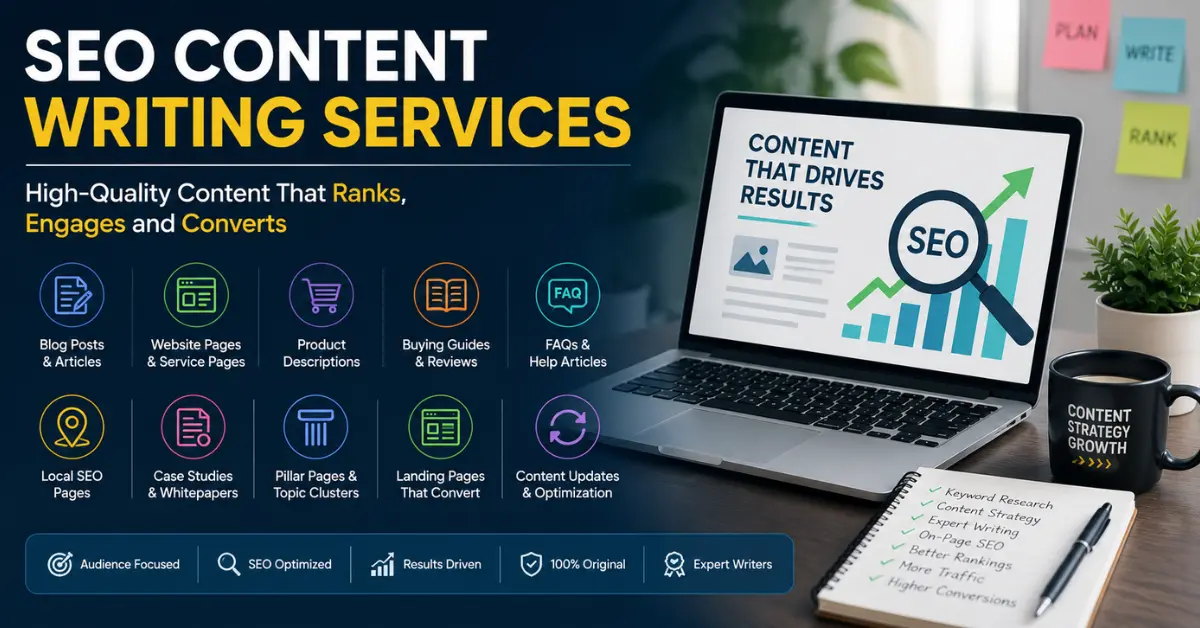
Types of SEO Content Writing Services We Provide
- Website pages (home, services, about)
- SEO blog posts
- Landing pages
- Product & category descriptions
- Local SEO content
- Long-form guides and pillar pages
- Content updates and rewrites
- Content briefs and editorial planning
Each content type serves a specific ranking and conversion purpose.
Why Content Decays Over Time
Even outstanding articles can lose rankings if they are never updated.
This gradual decline is known as content decay.
Common reasons include:
- Competitors publish more comprehensive content.
- Industry trends evolve.
- Search intent shifts.
- Statistics become outdated.
- Internal links change.
- New questions emerge.
Signs Your Content Needs an Update
- Organic traffic starts declining.
- Rankings drop without major algorithm changes.
- Competitors cover topics your article misses.
- Outdated screenshots or examples remain on the page.
- New industry developments are not mentioned.
Instead of creating new content for every opportunity, updating existing pages is often one of the fastest ways to regain visibility.
Building Topical Authority
Publishing one excellent article is helpful.
Publishing a collection of interconnected articles around the same subject is far more powerful.
This approach is known as topical authority.
For example, if your main service page targets SEO content writing services, supporting articles might include:
- How to Write SEO-Friendly Content
- What Is Search Intent?
- On-Page SEO Best Practices
- Content Optimization Checklist
- How to Refresh Old Blog Posts
- SEO Copywriting vs Content Writing
- Pillar Pages and Topic Clusters Explained
- Common SEO Content Mistakes
These supporting pages reinforce your expertise and help search engines understand the depth of your knowledge.
The Role of Internal Linking
Internal links are more than navigation. They help search engines understand how your content is connected and guide visitors toward relevant information.
A well-planned internal linking strategy can:
- Strengthen topical relevance.
- Distribute authority across important pages.
- Improve crawling and indexing.
- Increase the average time users spend on your website.
- Encourage visitors to explore related content.
Internal Linking Best Practices
✔ Link naturally within relevant content.
✔ Use descriptive anchor text instead of generic phrases like “click here.”
✔ Connect service pages with supporting blog articles.
✔ Review older content regularly and add links to newly published pages.
✔ Avoid excessive or irrelevant internal links that interrupt the reading experience.
When done thoughtfully, internal linking benefits both users and search engines, making it an essential part of any long-term SEO strategy.
Our SEO Content Writing Process
Publishing content without a structured workflow often leads to inconsistent quality and disappointing results. A repeatable process ensures that every page is created with a clear purpose, supports your business goals, and meets user expectations.
Our approach focuses on research, strategy, writing, optimization, and continuous improvement rather than simply producing large volumes of content.
Step 1: Business and Audience Research
Every successful content strategy starts with understanding the business behind it.
Before writing, we identify:
- Your products or services
- Your ideal customers
- Your competitors
- Your unique selling points
- Your business objectives
Instead of asking, “Which keyword has the highest search volume?” we ask, “What information does your ideal customer need before choosing your business?”
This shift creates content that attracts qualified visitors rather than random traffic.
Step 2: Search Intent and Keyword Research
Keyword research is about understanding how people search, not collecting as many keywords as possible.
We analyze:
- Primary keyword
- Secondary keywords
- Long-tail search terms
- Related questions
- Search intent
- SERP features
- Competitor content gaps
The goal is to create one page that answers multiple relevant questions naturally.
Quick Checklist
✅ Primary keyword selected
✅ Supporting keywords identified
✅ Search intent confirmed
✅ Competitor gaps documented
✅ Related questions collected
Step 3: Content Planning
Before writing begins, we create a clear content outline.
This includes:
- Heading structure
- Important topics
- Supporting examples
- Internal linking opportunities
- Calls to action
- FAQ ideas
Planning first helps avoid repetitive sections and improves the overall reading experience.
Step 4: Writing Content That Builds Trust
Writing is not about filling a word count.
Every paragraph should answer a question, solve a problem, or move the reader closer to making a decision.
Our writing principles include:
- Simple, natural language
- Logical flow
- Actionable advice
- Realistic examples
- Clear explanations
- Smooth transitions
Readers should finish each section feeling that they learned something valuable.
Step 5: On-Page SEO Optimization
Once the content is complete, we optimize it without compromising readability.
This includes:
- SEO-friendly title
- Meta description
- Heading hierarchy
- Natural keyword placement
- Image optimization
- Internal linking
- External references
- URL optimization
Optimization should support the reader’s experience, not distract from it.
Step 6: Content Review and Quality Assurance
Before publication, every page goes through a final review.
We verify:
- Accuracy
- Clarity
- Grammar
- Readability
- Search intent alignment
- Internal links
- Conversion opportunities
This quality check reduces errors and ensures the content is ready for both users and search engines.
Types of SEO Content Writing Services
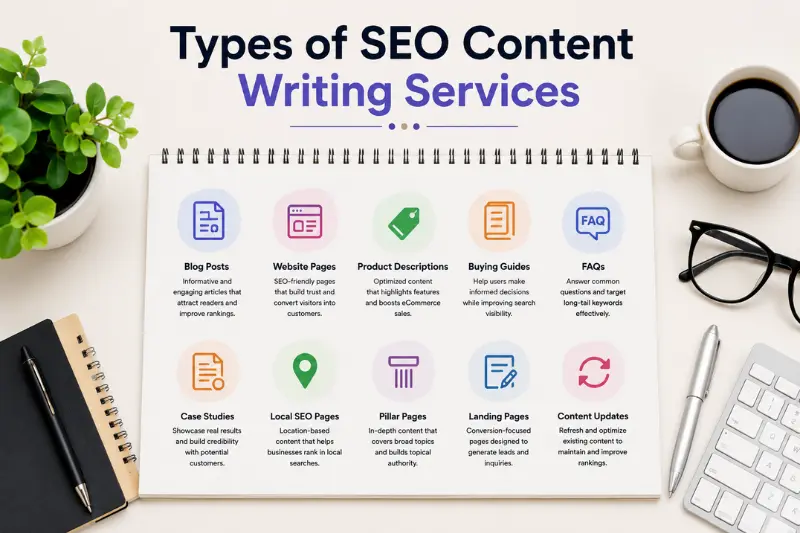
Different business goals require different types of content. Using the right format improves both rankings and conversions.
| Content Type | Primary Purpose |
|---|---|
| Service Pages | Generate leads and inquiries |
| Landing Pages | Increase conversions |
| Blog Articles | Attract informational traffic |
| Pillar Pages | Build topical authority |
| Product Descriptions | Improve ecommerce visibility |
| Category Pages | Target commercial keywords |
| Local SEO Pages | Reach nearby customers |
| Content Updates | Maintain rankings |
| Buying Guides | Support purchasing decisions |
| Case Studies | Build trust and credibility |
Each content type plays a different role within an effective SEO strategy.
What Makes High-Quality SEO Content?
Many pages rank briefly before disappearing because they focus on search engines instead of readers.
Strong SEO content balances optimization with genuine usefulness.
High-quality content should:
- Solve a specific problem
- Match user intent
- Be easy to read
- Be factually accurate
- Demonstrate expertise
- Encourage action
- Stay relevant over time
If visitors leave with unanswered questions, the content still has room for improvement.
Common Mistakes That Prevent Content From Ranking
Many websites invest in content but unknowingly repeat the same mistakes.
1. Writing Without Research
Publishing without understanding user intent often results in content that attracts little traffic.
2. Chasing Keywords Instead of Topics
Focusing on isolated keywords creates disconnected pages.
Building topic clusters usually produces stronger long-term results.
3. Ignoring Internal Links
A page without internal links becomes isolated.
Connecting related articles strengthens your site’s structure and improves discoverability.
4. Publishing Thin Content
Covering a topic superficially often leads users back to Google.
Aim to answer the main question and the important follow-up questions.
5. Never Updating Content
Search results change.
Content should evolve with industry trends and user expectations.
Example Scenario
Imagine two companies offering identical SEO content writing services.
Company A
- Publishes one generic service page.
- Uses the target keyword repeatedly.
- Never updates the content.
- Provides little practical advice.
Company B
- Creates a comprehensive service page.
- Adds supporting blog articles.
- Includes examples and helpful checklists.
- Updates content regularly.
- Builds internal links between related pages.
Over time, Company B is far more likely to build authority, improve rankings, and attract qualified leads because its content better serves users.
SEO Content Checklist Before Publishing
Use this checklist before every article goes live.
Content Quality
- Clear introduction
- Logical structure
- Original insights
- Practical examples
- Helpful conclusion
SEO
- Primary keyword used naturally
- Supporting keywords included
- Proper heading hierarchy
- Internal links added
- External references included
User Experience
- Short paragraphs
- Bullet points
- Tables where useful
- Mobile-friendly formatting
- Fast-loading images
Conversion
- Clear call to action
- Contact options visible
- Trust signals included
Completing this checklist helps ensure your content is useful, optimized, and ready to perform.
Professional SEO Content vs Generic Content
| Generic Content | Professional SEO Content |
|---|---|
| Written for search engines | Written for people first |
| Focuses on keywords | Focuses on solving problems |
| Repeats competitor ideas | Adds unique insights |
| Rarely updated | Regularly reviewed and improved |
| Limited internal links | Strong topical connections |
| Generates traffic only | Generates traffic and conversions |
Expert Tips for Long-Term Success
Small improvements made consistently often outperform major changes made once.
Keep these best practices in mind:
- Review important pages every three to six months.
- Monitor search intent for your target keywords.
- Expand successful articles instead of constantly publishing new ones.
- Build topic clusters around your core services.
- Use internal links to connect related pages naturally.
- Prioritize user satisfaction over keyword frequency.
Businesses that treat content as an ongoing asset rather than a one-time project are more likely to achieve sustainable organic growth.
How Long Does SEO Content Take to Deliver Results?
SEO content is a long-term investment. Unlike paid advertising, it does not produce instant traffic, but it continues to generate value long after publication.
The exact timeline depends on factors such as your website’s authority, competition, content quality, and consistency.
Typical SEO Timeline
| Timeframe | What You Can Expect |
|---|---|
| 2 to 4 Weeks | Google crawls and indexes new content, initial impressions begin to appear. |
| 1 to 3 Months | Rankings start improving for low and medium competition keywords. |
| 3 to 6 Months | Organic traffic increases, more keywords begin ranking, and qualified leads may grow. |
| 6 to 12 Months | Strong topical authority develops, rankings become more stable, and long-term ROI improves. |
Remember that SEO is not a one-time campaign. The businesses that consistently publish and improve quality content usually achieve the strongest long-term results.
How Much Do SEO Content Writing Services Cost?
There is no universal pricing because every project requires a different level of research, expertise, and optimization.
Pricing is usually influenced by factors such as:
- Industry competition
- Content length
- Research requirements
- Technical complexity
- Number of revisions
- Content strategy
- SEO optimization level
- Publishing frequency
Instead of choosing the lowest-priced option, consider the long-term value.
A well-written article can generate qualified traffic and leads for years, making it one of the highest-return investments in digital marketing.
Who Can Benefit From SEO Content Writing Services?
Professional SEO content is valuable for almost every business that wants to increase its online visibility.
It is especially beneficial for:
Local Businesses
Reach customers searching for nearby services and improve local search visibility.
Ecommerce Stores
Rank product and category pages for high-intent commercial searches.
SaaS Companies
Educate potential customers, demonstrate expertise, and generate qualified leads.
B2B Businesses
Build authority, answer buyer questions, and support longer sales cycles with educational content.
Healthcare Providers
Publish trustworthy, accurate information that helps patients make informed decisions.
Law Firms
Create informative content that answers legal questions while building credibility.
Home Service Companies
Attract local customers searching for electricians, plumbers, roofing contractors, cleaning services, and similar businesses.
Regardless of your industry, if potential customers search online before making a decision, SEO content can help your business become more visible.
How to Measure the Success of SEO Content
Publishing content is only the beginning.
To understand whether your strategy is working, monitor performance using meaningful metrics rather than focusing on rankings alone.
Key Performance Indicators
- Organic traffic growth
- Keyword rankings
- Click-through rate (CTR)
- Average engagement time
- Conversion rate
- Lead generation
- Form submissions
- Revenue from organic traffic
- Returning visitors
Successful SEO content creates measurable business outcomes, not just higher rankings.
Signs Your Content Needs an Update
Even high-performing pages should be reviewed regularly.
Consider refreshing your content if:
- Organic traffic begins declining.
- Rankings gradually decrease.
- Competitors publish more comprehensive content.
- Industry information changes.
- Statistics become outdated.
- User questions evolve.
- Internal links need improvement.
Updating existing pages is often faster and more cost-effective than creating new content from scratch.
Frequently Asked Questions
What is included in SEO content writing services?
SEO content writing services typically include keyword research, search intent analysis, content planning, professional writing, on-page optimization, internal linking, metadata creation, and ongoing content improvements.
How is SEO content different from regular content?
Regular content is often written to inform or entertain.
SEO content is strategically created to attract search traffic, satisfy user intent, improve visibility, and encourage meaningful actions such as inquiries, bookings, or purchases.
Can AI-generated content rank on Google?
Google evaluates content based on quality rather than the method used to create it. However, content that lacks originality, expertise, or value is unlikely to perform well, regardless of whether it is written by AI or a human.
The best results usually come from human-reviewed, experience-driven content that genuinely helps readers.
How often should SEO content be updated?
Important pages should generally be reviewed every three to six months.
Competitive industries may require more frequent updates to maintain rankings and ensure information remains accurate.
What is topical authority, and why is it important?
Topical authority is built by publishing comprehensive, interconnected content around a specific subject.
Instead of creating isolated articles, businesses establish expertise by covering related topics in depth and linking them together.
Can SEO content generate leads as well as traffic?
Yes.
High-quality SEO content attracts visitors who are actively searching for solutions. When combined with clear calls to action and a strong user experience, it can generate qualified leads, inquiries, and sales.
Conclusion
Effective SEO content writing is about far more than improving rankings.
It is about understanding your audience, answering their questions, demonstrating expertise, and creating content that supports real business goals.
A successful content strategy combines research, search intent, technical optimization, and valuable insights into a resource that continues to attract qualified visitors over time.
Rather than chasing algorithms or relying on outdated SEO tactics, focus on publishing content that people genuinely find useful. When your content consistently delivers value, search visibility, authority, and conversions naturally become stronger.
Investing in professional SEO content writing services is not simply an expense. It is an investment in a sustainable marketing asset that can continue generating traffic, leads, and business growth for years.